Wave Optics
138 PYQs → 35 unique concepts, 103 similar PYQs. The first 3 are free.
JEE Main 2024 · JEE Main 05 Apr 2024 Shift-I
Fringe width and fringe position: beta = lambda D/d, y_n = n beta
Huygens' Principle and Interference (YDSE)Asked 10 times (2020, 2021, 2023, 2024) • Solving this covers 9 similar PYQs
In Young's double slit experiment, carried out with light of wavelength 5000 Å, the distance between the slits is 0.3 mm and the screen is at 200 cm from the slits. The central maximum is at cm. The value of for third maxima is ______ mm.
Theory · how these 10 PYQs are the same concept
In YDSE bright fringes sit at and dark ones halfway between; the spacing is . The path difference at a point is . Any one of follows once the others are known. Traps: convert mm, cm and nm to metres; 'distance between the n-th bright fringes on both sides' is ; 'first to third bright' is , not .
How NTA asks it
Rotated by asking for beta, for the position of the n-th bright fringe, for the slit separation, the wavelength or frequency, or for the path difference at a given point on the screen.
- 2024 (Unique PYQ): Unique PYQ: compute beta from lambda, d, D and give the position of the third maximum.
- 2023: Unknown swapped: given the 5th bright fringe position, find the slit separation.
- 2021: Distance between 4th bright fringes on both sides (8 beta) gives lambda, then frequency.
- 2021: White light: first violet and red fringe positions give the wavelength difference.
- 2021: Same method; asks the distance between the first and third bright fringes (2 beta).
- 2021: Unknown swapped: wavelength from fringe width, d and D.
- 2021: Same formula; directly asks the fringe separation for 500 nm, 2 mm slits, 1 m screen.
- 2020: Same relation read backwards: path difference yd/D at a bright fringe 1.27 mm from centre.
- 2020: Same formula with 589 nm, 0.15 mm, 1.5 m; asks fringe width.
- 2020: Repeat of the 589 nm, 0.15 mm, 1.5 m numbers; asks spacing of successive bright fringes.
JEE Main 2023 · JEE Main 01 Feb 2023 Shift-II
Shift of fringes by a thin transparent sheet: (mu - 1)t
Huygens' Principle and Interference (YDSE)Asked 8 times (2019, 2022, 2023, 2024, 2026) • Solving this covers 7 similar PYQs
As shown in the figure, in Young's double slit experiment, a thin plate of thickness m and refractive index is inserted infront of slit . The experiment is conducted in air () and uses a monochromatic light of wavelength nm. Due to the insertion of the plate, central maxima is shifted by a distance of . is the fringe-width before the insertion of the plate. The value of the x is ______.
(See figure)
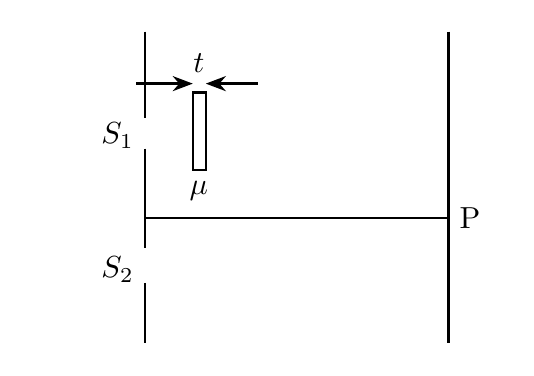
(See figure)
Theory · how these 8 PYQs are the same concept
A sheet of thickness and index in front of one slit adds optical path . The whole pattern shifts towards that slit by , i.e. by fringes. With sheets on both slits the net extra path is . If the extra path is a whole number of wavelengths, the centre again shows a maximum. Trap: using instead of ; fringe width itself is unchanged.
How NTA asks it
Asked for the shift distance, the thickness or mu from a shift, the number of fringes shifted, two slabs on both slits, or the plate thickness that keeps the central intensity unchanged.
- 2023 (Unique PYQ): Unique PYQ: plate t = 10 um, mu = 1.2; shift expressed in fringe widths.
- 2026: Same formula; find mu of a 20 um sheet from the shift.
- 2026: Same shift formula; find the sheet thickness from a 0.2 cm shift.
- 2024: Central maximum moves to 4th fringe: (mu - 1)t = 4 lambda gives t.
- 2023: Two slabs of different mu on both slits; net (mu2 - mu1)t gives fringes shifted.
- 2022: Plate of thickness x lambda leaves the central intensity unchanged: (mu - 1)t = n lambda.
- 2019: Shift of one fringe width: t = lambda/(mu - 1), symbolic.
- 2019: Shift of n fringe widths: t = n lambda/(mu - 1), symbolic with figure.
JEE Main 2022 · JEE Main 29 Jun 2022 Shift-I
Scaling of fringe width with lambda, d and D (ratio reasoning)
Huygens' Principle and Interference (YDSE)Asked 8 times (2021, 2022, 2023, 2025, 2026) • Solving this covers 7 similar PYQs
Using Young's double slit experiment, a monochromatic light of wavelength 5000 Å produces fringes of fringe width 0.5 mm. If another monochromatic light of wavelength 6000 Å is used and the separation between the slits is doubled, then the new fringe width will be:
Theory · how these 8 PYQs are the same concept
Since , any change is found by ratios without the absolute numbers: , , . Moving the screen by changes by . The position of a given order scales the same way. Trap: doubling halves (a 50% change), it does not double it; with a time-varying the extreme widths come from .
How NTA asks it
Asked as new fringe width after changing lambda or d, equal fringe width in two set-ups (find D ratio), screen shift giving the wavelength, % change in beta, oscillating slit separation, or a fringe position for a new wavelength.
- 2022 (Unique PYQ): Unique PYQ: lambda changes 5000 to 6000 A and d doubles; find the new fringe width.
- 2026: Two set-ups with equal fringe widths; ratios of d and lambda give the ratio of D.
- 2025: d doubled; asks the percentage change in fringe width (50%).
- 2025: Position of the 10th bright fringe rescaled for 660 nm instead of 600 nm.
- 2023: Only lambda changes (400 to 600 nm); beta scales in proportion.
- 2022: Screen shifted by Delta D; the change in beta gives the wavelength. Same beta formula.
- 2022: Same proportion read backwards: new beta gives the new wavelength.
- 2021: d varies as d0 + a0 sin wt; difference of largest and smallest beta from the same formula.
Single-slit minima angles: a sin theta = n lambda
Asked 8 times (2020, 2023, 2024, 2025) • covers 7 similar PYQs
Three or more polaroids between crossed polarisers
Asked 7 times (2019, 2023, 2024, 2025) • covers 6 similar PYQs
Intensity at a point from path or phase difference: I = I_max cos^2(phi/2)
Asked 7 times (2019, 2020, 2023, 2024) • covers 6 similar PYQs
Coincidence of bright fringes of two wavelengths: n1 lambda1 = n2 lambda2
Asked 6 times (2019, 2023, 2024, 2025, 2026) • covers 5 similar PYQs
Single-slit pattern on a screen: widths of central and secondary maxima
Asked 6 times (2022, 2024, 2026) • covers 5 similar PYQs
Imax/Imin from intensity or amplitude ratio of the two sources
Asked 6 times (2019, 2021, 2022, 2023, 2025) • covers 5 similar PYQs
Unequal slit widths: intensity or amplitude proportional to width
Asked 6 times (2019, 2021, 2024, 2025) • covers 5 similar PYQs
Malus' law with one polariser-analyser pair: I = I0 cos^2 theta
Asked 6 times (2020, 2021, 2022, 2024) • covers 5 similar PYQs
Brewster angle: tan i_B = mu2/mu1, reflected and refracted rays perpendicular
Asked 4 times (2023, 2024, 2026) • covers 3 similar PYQs
YDSE immersed in a medium: lambda -> lambda/mu, beta -> beta/mu
Asked 4 times (2022, 2025) • covers 3 similar PYQs
Exact path difference geometry: minimum directly opposite a slit
Asked 4 times (2019, 2022, 2023, 2024) • covers 3 similar PYQs
Counting fringes in a fixed segment or angular range
Asked 4 times (2019, 2020) • covers 3 similar PYQs
Wavefront shapes and Huygens' construction
Asked 3 times (2024, 2025, 2026) • covers 2 similar PYQs
Locating a point of given intensity on the YDSE screen
Asked 3 times (2024, 2026) • covers 2 similar PYQs
Optical path, wavelength in a medium and phase difference
Asked 3 times (2020, 2021, 2025) • covers 2 similar PYQs
Difference of maximum and minimum intensities: 4 sqrt(I1 I2)
Asked 3 times (2022, 2024, 2025) • covers 2 similar PYQs
Effect of colour of light on fringe spacing (qualitative)
Asked 3 times (2021, 2025) • covers 2 similar PYQs
Double slit with finite slit width: interference fringes inside the diffraction envelope
Asked 3 times (2019, 2024, 2025) • covers 2 similar PYQs
Resultant intensity at arbitrary phase: I1 + I2 + 2 sqrt(I1 I2) cos phi
Asked 3 times (2022, 2024) • covers 2 similar PYQs
Brewster angle reasoning: reverse direction, p-polarised light, TIR limit
Asked 3 times (2019, 2022, 2023) • covers 2 similar PYQs
(Imax + Imin)/(Imax - Imin) for two coherent sources
Asked 3 times (2021, 2022) • covers 2 similar PYQs
Resolving power and limit of resolution: theta = 1.22 lambda/D
Asked 3 times (2019, 2020) • covers 2 similar PYQs
Angular fringe width theta = lambda/d
Asked 2 times (2020, 2026) • covers 1 similar PYQ
Thin film interference: phase change on reflection and thickness
Asked 2 times (2025) • covers 1 similar PYQ
Diffraction vs scattering: obstacle or aperture size relative to wavelength
Asked 2 times (2021, 2022) • covers 1 similar PYQ
Superposing waves with initial phase differences (phasors)
Asked 2 times (2020) • covers 1 similar PYQ
Coherence: why two different colours or sources give no fringes
Asked in 2025
Limits of wave theory: phenomena needing the photon picture
Asked in 2025
Polarisers combined with YDSE: making beams coherent and polarised alike
Asked in 2025
Doppler shift of light: Delta lambda / lambda = v/c
Asked in 2022
Resolving power of a particle microscope: lambda = h/mv
Asked in 2021
Rotating polariser in polarised light: time-averaged Malus' law
Asked in 2020