Current Electricity
308 PYQs → 76 unique concepts, 232 similar PYQs. The first 3 are free.
JEE Main 2022 · JEE Main 24 Jun 2022 Shift-II
Potentiometer driver circuit: potential gradient and series resistance
Meter Bridge, Potentiometer and Measuring InstrumentsAsked 11 times (2019, 2020, 2021, 2022) • Solving this covers 10 similar PYQs
A potentiometer wire of length 10 m and resistance is connected in series with a 25 V battery and an external resistance . A cell of emf E in secondary circuit is balanced by 250 cm long potentiometer wire. The value of E (in volt) is . The value of x is ______.
Theory · how these 11 PYQs are the same concept
The driver current is and the potential gradient is . A cell balancing at length l has emf (no current through it at null). Working backwards, the null length of a small emf fixes k, then I, then the series resistance or the wire resistance. Trap: including the secondary cell's internal resistance at balance.
How NTA asks it
Series resistance for a given gradient, wire resistance from a null point, emf of a cell, maximum measurable emf, or null position on a wire with its own cell.
- 2022 (Unique PYQ): Unique PYQ: 10 m, 20 Ω wire with 25 V and 30 Ω; gradient 1 V/m, E for 250 cm.
- 2022: Null for 20 mV at 60 cm fixes wire p.d.; series resistance-box value asked.
- 2022: Same data as 204 with the wire resistance as the unknown.
- 2021: Maximum emf measurable = full p.d. across the wire from the driver circuit.
- 2020: Null at 49 cm from Q; balance length from P gives the gradient.
- 2020: 60 mA through a 1200 cm wire, 5 V cell at 1000 cm; wire resistance.
- 2020: Same data as 232; internal resistance of the balanced cell is irrelevant.
- 2019: Four-wire potentiometer; voltmeter reading at 50 cm from the driver current.
- 2019: Series R for 5 mV across 10 cm of a 5 Ω wire.
- 2019: Same null with different rheostat values; emf ratio from driver currents.
- 2019: Wire 12r with cell r; null for ε/2 at 13L/24.
JEE Main 2021 · JEE Main 31 Aug 2021 Shift-II
Shorted resistors and redrawing by nodes (wires, switches)
Combination of Resistances and Kirchhoff's LawsAsked 10 times (2020, 2021, 2022, 2023, 2024, 2025) • Solving this covers 9 similar PYQs
The equivalent resistance of the given circuit between the terminals A and B is :
(See figure)
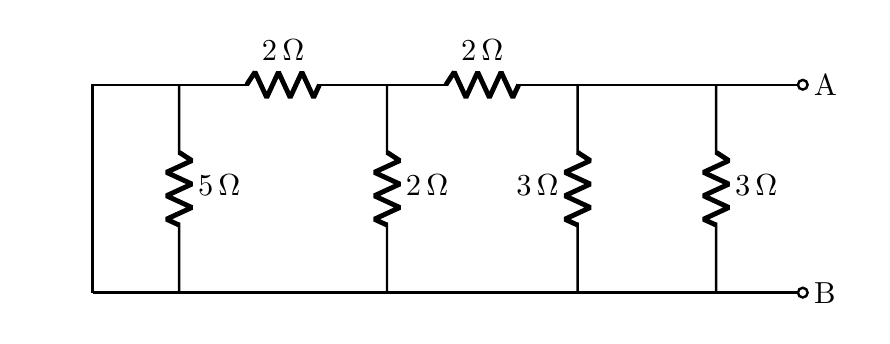
(See figure)
Theory · how these 10 PYQs are the same concept
A connecting wire of zero resistance makes its two ends one node. Label every node, merge points joined by plain wires, and redraw. A resistor whose two ends lie on the same node is shorted and carries no current. Closing a switch merges nodes in the same way. Trap: keeping a shorted resistor in the calculation or missing that crossing wires join far-apart junctions.
How NTA asks it
Networks whose wires short some resistors, crossing links that put everything in parallel, switch open vs closed, or the current in a shorting wire.
- 2021 (Unique PYQ): Unique PYQ: leftmost wire shorts the 5 Ω; remaining reduction gives 1 Ω.
- 2025: Cross wires put three r/3 resistors in parallel between the ends; R = r/9.
- 2024: Same network idea: 6 Ω shorted, then 2∥2, series and triple parallel.
- 2023: Wires join A to D and C to B, so every resistor lies directly across A–B.
- 2023: Vertical wires make A and B single nodes; branches in parallel.
- 2023: Vertical wire shorts part of the network; those resistors carry no current.
- 2022: Connecting wires put all three 9 Ω resistors in parallel.
- 2022: Top arc joins the ends of two resistors, putting them in parallel.
- 2020: B and C joined by a wire; current in that wire from node currents.
- 2020: Same circuit as 132 asking the current in the B–D wire.
JEE Main 2023 · JEE Main 24 Jan 2023 Shift-II
Voltmeter loading: finite meter resistance changes the reading
Meter Bridge, Potentiometer and Measuring InstrumentsAsked 9 times (2019, 2020, 2022, 2023, 2024, 2026) • Solving this covers 8 similar PYQs
A cell of emf 90 V is connected across series combination of two resistors each of resistance. A voltmeter of resistance is used to measure the potential difference across each resistor. The reading of the voltmeter will be :
Theory · how these 9 PYQs are the same concept
A voltmeter of resistance placed across R forms the parallel combination , which lowers that part's resistance and so the reading. Re-solve the circuit with the voltmeter included. The higher , the less it disturbs the circuit. Trap: assuming the reading equals the ideal voltage-divider value.
How NTA asks it
Reading of a 400 Ω, 2 kΩ or 10 kΩ voltmeter across one resistor, voltmeter resistance from its reading, or % error in R = V/I.
- 2023 (Unique PYQ): Unique PYQ: 400 Ω voltmeter across one of two 100 Ω resistors on 90 V; reading 40 V.
- 2026: Same loading with 9 V supply and 400 Ω voltmeter.
- 2024: V–I graph slope gives R ∥ 10 kΩ voltmeter; true R extracted.
- 2024: Unknown swapped: reading given, voltmeter resistance asked.
- 2023: Same as 192 with 2 V across 5 Ω; voltmeter resistance asked.
- 2023: Assertion–reason: higher-resistance voltmeter preferred as it draws less current.
- 2022: Same loading: 2000 Ω meter across 500 Ω; reading 8 V.
- 2020: Same loading with a 10 kΩ meter across 400 Ω; reading just under 2 V.
- 2019: Measured R = V/I is 5% low; parallel combination gives R_V = 19R.
Current or voltage in one branch: current division in series–parallel
Asked 9 times (2019, 2020, 2021, 2023, 2024) • covers 8 similar PYQs
Kirchhoff/nodal analysis with several emfs
Asked 9 times (2019, 2020, 2021, 2023, 2024) • covers 8 similar PYQs
Galvanometer to voltmeter: series R = V/I_g − G
Asked 9 times (2019, 2020, 2023, 2024) • covers 8 similar PYQs
Galvanometer to ammeter: shunt S = I_gG/(I − I_g)
Asked 8 times (2019, 2023, 2024, 2025, 2026) • covers 7 similar PYQs
Power ratios in series and parallel: P = I²R vs P = V²/R
Asked 8 times (2019, 2022, 2023, 2024, 2025) • covers 7 similar PYQs
Metre bridge: null shift after adding a resistor in parallel or series
Asked 7 times (2019, 2022, 2023, 2024, 2026) • covers 6 similar PYQs
Wire bent into polygon: two parallel paths between vertices
Asked 7 times (2019, 2021, 2023, 2025) • covers 6 similar PYQs
Choose a combination: max/min R, cut-wire pieces, target value
Asked 6 times (2021, 2022, 2023, 2024, 2025) • covers 5 similar PYQs
Metre bridge balance: R/S = l/(100 − l)
Asked 6 times (2019, 2021, 2022, 2024) • covers 5 similar PYQs
Current sharing in a shunted galvanometer (fraction through G)
Asked 6 times (2019, 2021, 2022, 2024) • covers 5 similar PYQs
Joule heating H = I²Rt: scaling with current and time
Asked 6 times (2021, 2022, 2023, 2024) • covers 5 similar PYQs
Stretching: percentage change in R at constant volume (ΔR/R = 2Δl/l)
Asked 6 times (2019, 2021, 2022, 2023) • covers 5 similar PYQs
Recognise a balanced Wheatstone bridge inside a network
Asked 6 times (2020, 2021, 2022, 2023) • covers 5 similar PYQs
Symmetry/equipotential method (hexagon, cube, diamond, tetrahedron)
Asked 5 times (2024, 2025, 2026) • covers 4 similar PYQs
Capacitor in a DC circuit at steady state
Asked 5 times (2020, 2023, 2025, 2026) • covers 4 similar PYQs
Find an unknown arm for bridge balance (P/Q = R/S)
Asked 5 times (2020, 2022, 2023, 2024, 2025) • covers 4 similar PYQs
Series–parallel reduction for R_eq and total current
Asked 5 times (2019, 2021, 2022, 2024) • covers 4 similar PYQs
Terminal voltage V = E − Ir: find current or V
Asked 5 times (2020, 2021, 2022, 2024) • covers 4 similar PYQs
Galvanometer sensitivity and figure of merit (I ∝ θ)
Asked 5 times (2020, 2021, 2022, 2024) • covers 4 similar PYQs
Rated appliances: R = V²/P and power at another voltage or in series
Asked 5 times (2019, 2022, 2024) • covers 4 similar PYQs
Find internal resistance or emf from load data
Asked 5 times (2019, 2021, 2022, 2023) • covers 4 similar PYQs
Zero terminal p.d. of one cell in a series pair
Asked 5 times (2020, 2021, 2022) • covers 4 similar PYQs
Wire bent into a circle: arcs in parallel
Asked 4 times (2019, 2021, 2025, 2026) • covers 3 similar PYQs
Same current with cells in series or parallel ⇒ r = R
Asked 4 times (2021, 2022, 2023, 2026) • covers 3 similar PYQs
Measuring instruments: correct use and what can be measured
Asked 4 times (2020, 2023, 2026) • covers 3 similar PYQs
Potentiometer: internal resistance from shunted-cell balance lengths
Asked 4 times (2020, 2022, 2024, 2026) • covers 3 similar PYQs
Potential divider and sliding contact with a load
Asked 4 times (2021, 2024, 2025, 2026) • covers 3 similar PYQs
Charge from time-varying current: q = ∫I dt
Asked 4 times (2021, 2024, 2025) • covers 3 similar PYQs
Cells in parallel: equivalent emf E_eq = Σ(E/r)/Σ(1/r)
Asked 4 times (2019, 2023, 2025) • covers 3 similar PYQs
Resistance from geometry: R = ρl/A (and ρ as material property)
Asked 4 times (2022, 2023, 2024) • covers 3 similar PYQs
What moves a metre bridge null: wire changes vs gap resistor changes
Asked 4 times (2020, 2022, 2024) • covers 3 similar PYQs
Series resistor to run a rated device on a higher supply
Asked 4 times (2021, 2022, 2024) • covers 3 similar PYQs
Drift velocity from current: v_d = I/(neA)
Asked 4 times (2019, 2021, 2023) • covers 3 similar PYQs
Stretch by a factor n: R becomes n²R (incl. length from mass)
Asked 4 times (2022, 2023) • covers 3 similar PYQs
Drift velocity dependence: v_d = eEτ/m = eVτ/(ml)
Asked 4 times (2021, 2022, 2023) • covers 3 similar PYQs
Junction rule with given branch currents or node potentials
Asked 4 times (2019, 2020, 2022, 2023) • covers 3 similar PYQs
Potentiometer: emf ∝ balancing length (comparison of cells)
Asked 4 times (2021, 2022, 2023) • covers 3 similar PYQs
Parallel wires of different materials or numbers: effective R and ρ
Asked 4 times (2021, 2022) • covers 3 similar PYQs
Colour code of carbon resistors
Asked 4 times (2019, 2021) • covers 3 similar PYQs
Self-similar and ladder networks: repeated reduction or R_eq = X
Asked 3 times (2022, 2026) • covers 2 similar PYQs
Power dissipated in a network: P = E²/(R_eq + r) or I²R_eq
Asked 3 times (2021, 2024, 2026) • covers 2 similar PYQs
Inductor at t = 0 and ideal diodes: open or short branches
Asked 3 times (2020, 2022, 2025) • covers 2 similar PYQs
Ammeter with shunt and voltmeters in a circuit (KVL readings)
Asked 3 times (2024, 2025) • covers 2 similar PYQs
Find temperature or current from R = R₀(1 + αΔT)
Asked 3 times (2023, 2024) • covers 2 similar PYQs
Find α from resistances at two temperatures
Asked 3 times (2021, 2022, 2024) • covers 2 similar PYQs
Wire drawn or remoulded: R ∝ 1/r⁴ at constant volume
Asked 3 times (2023, 2024) • covers 2 similar PYQs
Cells in opposition: net emf, charging cell V = E + Ir
Asked 3 times (2021, 2023, 2024) • covers 2 similar PYQs
Wheatstone balance combined with another idea (α, colour code, P↔Q swap)
Asked 3 times (2019, 2024) • covers 2 similar PYQs
Cut wire reconnected: change in power at fixed voltage
Asked 3 times (2021, 2023, 2024) • covers 2 similar PYQs
Microscopic Ohm's law: J = σE, E = ρJ, with J = I/A
Asked 3 times (2021, 2022) • covers 2 similar PYQs
Mobility from drift velocity and field: μ = v_d/E
Asked 2 times (2019, 2026) • covers 1 similar PYQ
Unbalanced Wheatstone bridge with a finite middle arm: nodal analysis
Asked 2 times (2021, 2026) • covers 1 similar PYQ
Potential difference across an unbalanced bridge (two branches)
Asked 2 times (2020, 2026) • covers 1 similar PYQ
Maximum power transfer: R = r
Asked 2 times (2019, 2026) • covers 1 similar PYQ
Error propagation in combined electrical measurements
Asked 2 times (2021, 2026) • covers 1 similar PYQ
Transmission line efficiency: line loss I²R
Asked 2 times (2020, 2026) • covers 1 similar PYQ
Counting charge carriers and stored charge: n/t = I/e, q = It
Asked 2 times (2024, 2025) • covers 1 similar PYQ
Standard resistors use alloys with tiny temperature coefficient
Asked 2 times (2022, 2025) • covers 1 similar PYQ
Electric kettle: heat required = P·t with P = V²/R
Asked 2 times (2019, 2024) • covers 1 similar PYQ
Current as slope of charge: I = dq/dt (extrema and graphs)
Asked 2 times (2019, 2023) • covers 1 similar PYQ
Resistivity of materials and its temperature dependence (statements)
Asked 2 times (2020, 2023) • covers 1 similar PYQ
Current through an annular region with uniform J
Asked 2 times (2022) • covers 1 similar PYQ
Optimising combinations: minimum of s/p or of R_eq
Asked 2 times (2021, 2022) • covers 1 similar PYQ
Switch open vs closed: change in equivalent resistance
Asked 2 times (2021) • covers 1 similar PYQ
Radial resistance by integration: dR = ρ dr / A(r)
Asked 2 times (2019, 2020) • covers 1 similar PYQ
Fuse rating from total load: I = ΣP/V
Asked 2 times (2020) • covers 1 similar PYQ
Thermoelectric material: low thermal, high electrical conductivity
Asked in 2025
Motor efficiency: power loss converted to cal/s
Asked in 2025
Temperature coefficient of series and parallel combinations
Asked in 2024
Heating by AC vs DC: use rms current
Asked in 2022
Scaling of R and I when length and area change: R ∝ l/A
Asked in 2021
Reading an R–T graph: linearised exponential law
Asked in 2019
Resistivity from free-electron model: ρ = m/(ne²τ)
Asked in 2019