Capacitance
135 PYQs → 35 unique concepts, 100 similar PYQs. The first 3 are free.
JEE Main 2025 · JEE Main 23 Jan 2025 Shift-II
Capacitor in a DC circuit at steady state: no current in its branch
Combination of Capacitors and CircuitsAsked 13 times (2019, 2021, 2022, 2023, 2024, 2025, 2026) • Solving this covers 12 similar PYQs
At steady state the charge on the capacitor, as shown in the circuit below, is ________ C.
(See figure)
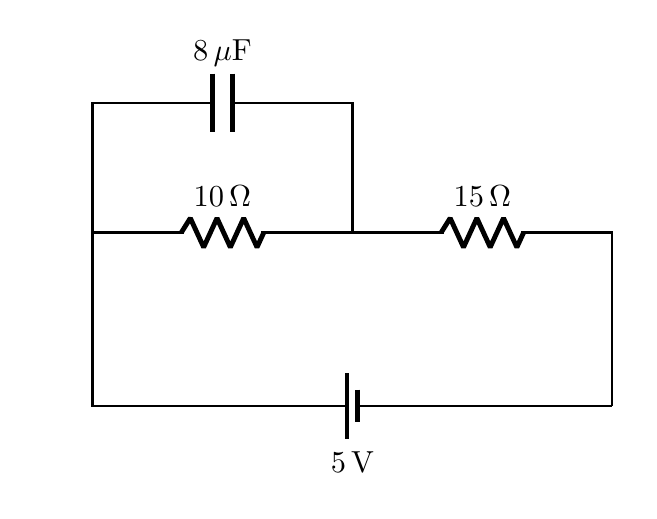
(See figure)
Theory · how these 13 PYQs are the same concept
In steady state a capacitor branch carries no current, so treat it as an open circuit. Find currents in the resistor network with Ohm's and Kirchhoff's laws, then read the capacitor's voltage as the potential difference between its two nodes; a resistor in series with the capacitor drops nothing. Then and . Trap: letting current flow through the capacitor branch or dropping voltage on its series resistor.
How NTA asks it
Asked for the charge, the charge ratio of two capacitors, or the stored energy; settings include bridges, a diode, a battery with internal resistance and a wire-loop square.
- 2025 (Unique PYQ): Unique PYQ: simple loop with 5 V; capacitor across 10 Ω gets 2 V, charge 16 μC.
- 2026: Same open-capacitor rule with a reverse-biased diode removing one branch.
- 2024: Same rule with a galvanometer; voltages across two capacitors give a 1 : 2 charge ratio.
- 2024: Same: capacitor branch carries no current, so it takes the voltage of R3.
- 2024: Same with A and B joined by a wire; find the node potential and the 6 μF charge.
- 2024: Same rule in a 16 Ω square loop with the capacitor across a diagonal; asks energy.
- 2024: Same, capacitor between midpoints of two divider arms; V = VA − VB.
- 2023: Same: capacitor across the 6 Ω resistor, 1.8 V and 7.2 μC.
- 2023: Same rule between midpoints of two branches; asks energy in μJ.
- 2022: Same, numbers 10 Ω and 100 Ω with a 1.1 μF capacitor.
- 2021: Same in a kΩ resistor chain; charge on the upper plate.
- 2021: Same with internal resistance; capacitor network across the terminal voltage.
- 2019: Same with a mixed resistor network; capacitor takes the voltage of one branch.
JEE Main 2024 · JEE Main 31 Jan 2024 Shift-I
Partially filled capacitor: C = ε0A/(d − t + t/K)
DielectricsAsked 12 times (2021, 2022, 2023, 2024, 2026) • Solving this covers 11 similar PYQs
A parallel plate capacitor with plate separation mm is charged up by a battery. It is found that on introducing a dielectric sheet of thickness mm, while keeping the battery connections intact, the capacitor draws more charge from the battery than before. The dielectric constant of the sheet is ______
Theory · how these 12 PYQs are the same concept
A slab of thickness and full area in a gap acts as air and dielectric in series: . Each slab reduces the effective air gap by . At fixed battery voltage the charge grows in the same ratio as . To restore the old , move the plate by . Trap: writing instead of , or using the parallel formula for a full-area slab.
How NTA asks it
Asked as the new C for t = d/2, d/3, 3d/4, as extra charge drawn (25% more), as the plate shift that restores C, or as a ratio between two slab thicknesses; options in symbols or numbers.
- 2024 (Unique PYQ): Unique PYQ: 2 mm sheet in a 5 mm gap draws 25% more charge at fixed V; K = 2.
- 2026: Repeat of the 2 mm mica in 5 mm gap drawing 25% more charge; same formula, K = 2.
- 2026: Same formula in symbols, slab of thickness d/3; C' = 3KC/(2K + 1).
- 2024: Unknown swapped: plate moved 0.2 cm to keep C fixed after inserting a full slab; K = 1.5.
- 2023: Same formula used as a ratio between t = d/3 and t = 2d/3 with K = 4.
- 2023: Same with t = d/2 and K = 1.5; 5 μF becomes 6 μF.
- 2023: Same, numeric: 40 cm², 2 mm gap, 1 mm slab of K = 5; (10/3)ε0.
- 2022: Same formula with t = 3d/4; C = 4KC0/(K + 3).
- 2022: Same formula with half the gap filled, K = 3; 4 μF becomes 6 μF.
- 2021: Same, numeric with large plates (100 m², 10 m gap, 5 m slab, K = 10); 161 pF.
- 2021: Same, numeric with 2 m², 1 m gap, 0.5 m slab, K = 3.2; about 3ε0.
- 2021: Repeat of t = 3d/4 asking C' in terms of C0; same result.
JEE Main 2023 · JEE Main 11 Apr 2023 Shift-II
Charge on one capacitor in a network: series share Q, parallel share V
Combination of Capacitors and CircuitsAsked 9 times (2019, 2020, 2021, 2022, 2023, 2025) • Solving this covers 8 similar PYQs
In the given circuit. F, F, F, F, F, F. The charge stored on capacitor is ______ C.
(See figure)
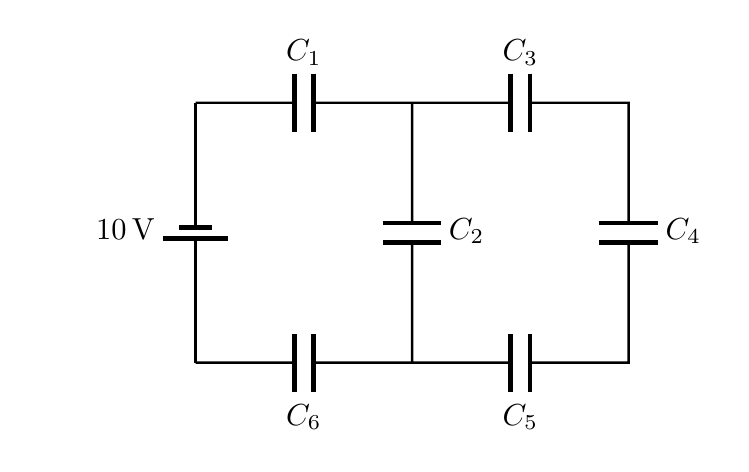
(See figure)
Theory · how these 9 PYQs are the same concept
First reduce to find the total charge . Capacitors in series carry the same charge; capacitors in parallel share the same voltage and split charge in proportion to . When the network is not series-parallel, set a junction potential and use zero net charge on the isolated node: . Trap: dividing charge equally in parallel, or voltage equally in series.
How NTA asks it
Asked for the charge on a named capacitor, a ratio of charges, the charge on a plate given another plate's charge, or via node analysis when three capacitors meet at one point.
- 2023 (Unique PYQ): Unique PYQ: six capacitors; reduce, find total charge, then split to get the charge on C4.
- 2025: Same reduction after K = 4 fills C1: 20 μF in series with 5, parallel with 5; 9 μF.
- 2022: Same series rule with K: one of two 40 μF in series is filled so C_eq = 24 μF; K = 1.5.
- 2022: Same: three in series on 13 V each carry 60 μC.
- 2021: Same: one capacitor alone across V, two in series beside it; ratio 1 : 2 : 2.
- 2020: Same charge rules done by node method: isolated junction, ΣC(x − Vi) = 0, charge on 5 μF.
- 2020: Same parallel rule: C3 at 20 V holds 160 μC, rest of 750 μC is on C2.
- 2019: Same: 1 and 5 μF in parallel, in series with 4 μF on 10 V; 24 μC.
- 2019: Same rules from a given plate charge −30 μC; split in ratio 6 : 4 for the 6 μF plate.
Compound dielectrics: layers in series, side-by-side blocks in parallel
Asked 8 times (2019, 2021, 2025, 2026) • covers 7 similar PYQs
Charge sharing: charged capacitor joined to another, common V = ΣQ/ΣC
Asked 7 times (2020, 2021, 2022, 2025, 2026) • covers 6 similar PYQs
Energy loss on joining two capacitors: ΔU = ½·C1C2/(C1+C2)·(V1 − V2)²
Asked 6 times (2019, 2020, 2024) • covers 5 similar PYQs
Energy lost when a charged capacitor shares with an identical uncharged one
Asked 6 times (2020, 2022, 2023) • covers 5 similar PYQs
Series vs parallel: equivalent C, stored energy, and q–V graph slopes
Asked 5 times (2019, 2020, 2021, 2024) • covers 4 similar PYQs
Parallel plate capacitance C = Kε0A/d and how it scales
Asked 4 times (2022, 2023, 2025, 2026) • covers 3 similar PYQs
RC charging: V = V0(1 − e^(−t/RC)), capacitor behaves as a short at t = 0
Asked 4 times (2020, 2021, 2025) • covers 3 similar PYQs
Stored energy U = Q²/2C = ½CV² and energy density ½ε0E²
Asked 4 times (2022, 2025) • covers 3 similar PYQs
Dielectric or plate change with charge fixed: U = Q²/2C, work done
Asked 4 times (2019, 2021, 2024) • covers 3 similar PYQs
Equivalent capacitance of series-parallel networks
Asked 4 times (2019, 2022, 2023) • covers 3 similar PYQs
Battery removed from a combination, then dielectric added: charge conserved
Asked 4 times (2019, 2021, 2022, 2023) • covers 3 similar PYQs
Capacitor with changing voltage: displacement current I = C dV/dt and reactance
Asked 3 times (2024, 2025) • covers 2 similar PYQs
Redraw by nodes: capacitors shorted or all between the same two points
Asked 3 times (2022, 2023, 2025) • covers 2 similar PYQs
Dielectric inserted with battery connected: V fixed, ΔQ = (K−1)CV, U ∝ K
Asked 3 times (2021, 2022, 2025) • covers 2 similar PYQs
Capacitance of a spherical conductor and spherical capacitor (C = 4πε0R)
Asked 3 times (2021, 2022, 2023) • covers 2 similar PYQs
Dielectric constant varying with depth: slices in series, 1/C = ∫dx/(ε(x)A)
Asked 3 times (2020, 2021) • covers 2 similar PYQs
Non-uniform gap: integrate thin strips in parallel (tilted plates, wedge dielectric)
Asked 3 times (2019, 2020) • covers 2 similar PYQs
Polar and non-polar dielectrics: permanent vs induced dipoles
Asked 2 times (2022, 2025) • covers 1 similar PYQ
Bound (induced) charge on a dielectric: q_b = q_f(1 − 1/K)
Asked 2 times (2021, 2025) • covers 1 similar PYQ
RC discharge: q = q0 e^(−t/RC), U ∝ e^(−2t/RC)
Asked 2 times (2022, 2024) • covers 1 similar PYQ
Stair-shaped plate: sections of different gap are capacitors in parallel
Asked 2 times (2022, 2024) • covers 1 similar PYQ
Multi-plate arrangements: each facing pair of plates is a capacitor
Asked 2 times (2021, 2023) • covers 1 similar PYQ
Metal sheet between plates: effective gap reduces to d − t
Asked 2 times (2022, 2023) • covers 1 similar PYQ
Field between plates E = σ/ε0 (one sheet alone gives σ/2ε0)
Asked 2 times (2019, 2022) • covers 1 similar PYQ
Plates with unequal charges q1, q2: V = (q1 − q2)/2C
Asked 2 times (2019, 2022) • covers 1 similar PYQ
Series dielectric layers: voltage split and field in each layer
Asked 2 times (2021, 2022) • covers 1 similar PYQ
Dielectric strength: maximum field E = q/(Kε0A) or V/d before breakdown
Asked 2 times (2019, 2022) • covers 1 similar PYQ
Slab pushed partly in along the length: two parallel sections
Asked 2 times (2020, 2022) • covers 1 similar PYQ
Diode in an RC circuit: discharge only if the diode is forward biased
Asked 2 times (2020) • covers 1 similar PYQ
Force between plates F = Q²/(2Kε0A) for a dielectric-filled capacitor
Asked in 2024
Battery switched off for one capacitor of a pair, then both filled with dielectric
Asked in 2022
Leakage current through a capacitor dielectric: RC = ρKε0
Asked in 2021