Electrostatics
222 PYQs → 59 unique concepts, 163 similar PYQs. The first 3 are free.
JEE Main 2026 · JEE Main 28 Jan 2026 Shift-I
Potential of point charges and work W = q(V_B − V_A)
Electric Potential and Potential EnergyAsked 9 times (2019, 2020, 2021, 2023, 2024, 2025, 2026) • Solving this covers 8 similar PYQs
Two point charges of 1 nC and 2 nC are placed at the two corners of equilateral triangle of side 3 cm. The work done in bringing a charge of 3 nC from infinity to the third corner of the triangle is ______ J.
Theory · how these 9 PYQs are the same concept
Potential is the scalar sum . Work by an external agent to move q is ; from infinity it is qV. Points equidistant from a charge are at the same potential, so no work is done between them. On a circle about one charge, only the other charge's distance changes. Trap: using vector addition or forgetting the sign of the charge.
How NTA asks it
Rotated as work to bring a charge to a triangle corner, between coordinates, along a semicircle, along a circle around one charge, distance from a given V, nucleus surface potential, or W = qV for a battery.
- 2026 (Unique PYQ): Unique PYQ: work to bring 3 nC to the third corner of a triangle, W = qV.
- 2026: Same; moving between two coordinate points near a point charge.
- 2025: Charge moved on a circle around q1; only q2's distance changes.
- 2024: Same V = kq/r at a nucleus surface with Z = 50.
- 2024: P and Q equidistant from the charge: potential difference zero.
- 2023: Reverse: distance from a given potential, r = kQ/V.
- 2021: Same W = qV with a battery moving 20 C through 15 V.
- 2020: Work along a semicircle depends only on end potentials from two charges.
- 2019: Work to put a fifth charge at the origin from four charges, W = QV.
JEE Main 2021 · JEE Main 25 Feb 2021 Shift-II
Flux through part of a closed surface by symmetry (cube, face, corner, hemisphere)
Gauss's Law and Electric FluxAsked 8 times (2021, 2022, 2023, 2024, 2025, 2026) • Solving this covers 7 similar PYQs
A charge '' is placed at one corner of a cube as shown in figure. The flux of electrostatic field through the shaded area is:
(See figure)
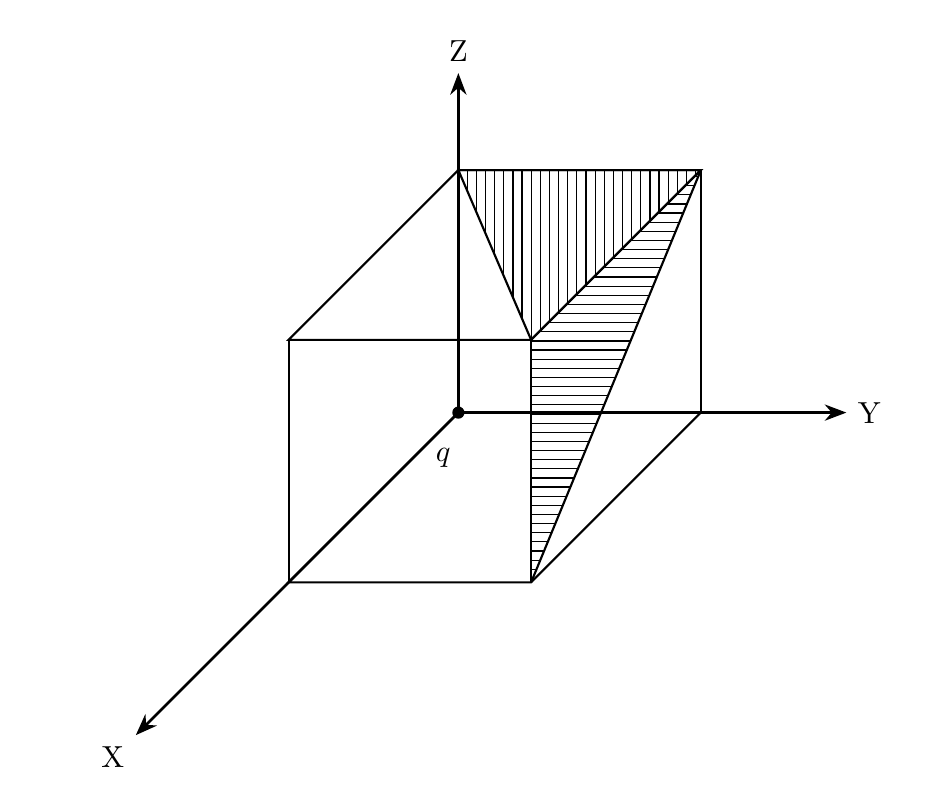
(See figure)
Theory · how these 8 PYQs are the same concept
Build a symmetric closed surface around the charge: a charge at a cube's centre sends q/6ε0 through each face; on a face centre the cube gets half, q/2ε0; at a corner 1/8; on an edge 1/4. A charge on the axis at a/2 from a square face is the centre of a cube, so q/6ε0. A hemisphere's curved part gets half. Trap: counting faces that touch the charge (they get zero flux).
How NTA asks it
Rotated as charge at a vertex and a face centre together, at a face centre, at a corner with a shaded face, a line charge on an edge, a square near a point charge, or flux through the flat face of a hemisphere.
- 2021 (Unique PYQ): Unique PYQ: charge at a cube corner; flux through a shaded face, q/24ε0.
- 2026: Same counting with charges at a vertex (1/8) and face centre (1/2).
- 2025: Square loop held at a/2 from a point charge; shaded part of a cube face.
- 2025: Line charge on an edge shared by four cubes: quarter of its enclosed charge.
- 2024: Charge at a face centre: the cube gets q/2ε0.
- 2023: Charge at the centre of a cuboid face; add a mirror cuboid to make a cube; opposite face flux.
- 2022: Same symmetry with a hemisphere: flux through its flat face.
- 2021: Square 6 cm below a charge is one face of a cube of side 12 cm: q/6ε0.
JEE Main 2020 · JEE Main 08 Jan 2020 Shift-I
Vector superposition of point-charge fields at a given point
Coulomb's Law and Electric FieldAsked 8 times (2019, 2020, 2021, 2022, 2024) • Solving this covers 7 similar PYQs
Three charged particles , and with charges , and are present on the circumference of a circle of radius . The charged particles , and centre of the circle formed an equilateral triangle as shown in figure. Electric field at along -direction is:
(See figure)
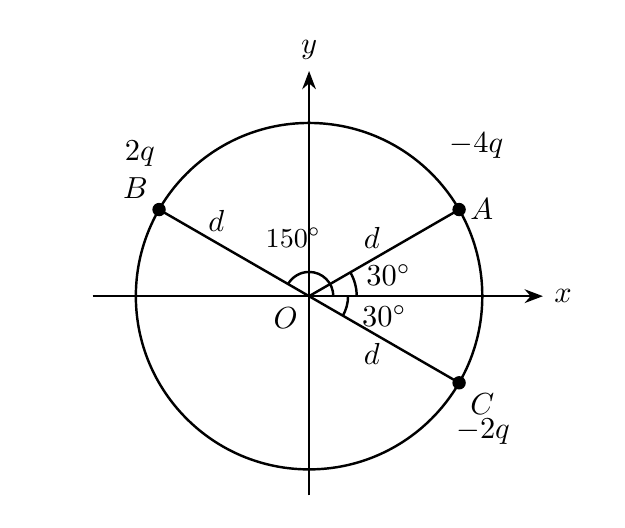
(See figure)
Theory · how these 8 PYQs are the same concept
Find each charge's field along the line joining it to the point (away from +, towards −), resolve into components and add. Zero field in one direction means the components cancel; a field perpendicular to a line means its component along that line is zero. Trap: adding magnitudes without directions, or using the wrong distance in a square or triangle.
How NTA asks it
Rotated as field at a square corner, at the centre of a circle with mixed charges, at a point on an axis, a ratio of charges for zero vertical field, or direction perpendicular to a hypotenuse.
- 2020 (Unique PYQ): Unique PYQ: three unequal charges on a circle; resolve their fields at the centre and add.
- 2024: Same component method: equate vertical components at P to get a charge ratio.
- 2022: Simplest form: field at midpoint of ±q adds; unknown is the separation d.
- 2022: Same superposition at a square corner from q/2, q, q/2.
- 2021: Same superposition with several charges on a figure of perpendicular sides of length l.
- 2020: Same vector sum at O; condition that the resultant is perpendicular to the hypotenuse gives Q1/Q2.
- 2020: Same circle set-up with different charge positions; asks only the x-component at the centre.
- 2019: Same method with coordinates: field at a point on the y-axis from two charges on the x-axis.
Gauss's law: flux = q_enclosed/ε0 (only enclosed charges count)
Asked 7 times (2023, 2024, 2025) • covers 6 similar PYQs
Infinite charged sheets: superpose σ/2ε0 from each sheet
Asked 7 times (2020, 2022, 2023, 2024, 2025) • covers 6 similar PYQs
Energy conservation for moving charges: KE gained = loss of electric PE
Asked 6 times (2019, 2020, 2026) • covers 5 similar PYQs
Concentric spherical shells: potential of each shell, equal-σ charge sharing
Asked 6 times (2019, 2020, 2023, 2026) • covers 5 similar PYQs
Null point of two charges (zero field or zero net force)
Asked 6 times (2019, 2021, 2023, 2024, 2025) • covers 5 similar PYQs
Gauss's law for spheres, shells and cylinders: field inside and outside
Asked 6 times (2020, 2022, 2023, 2024, 2025) • covers 5 similar PYQs
Torque on a dipole in a uniform field: τ = p × E
Asked 6 times (2022, 2023, 2024, 2025) • covers 5 similar PYQs
Flux of a position-dependent field through a cube or box face
Asked 6 times (2020, 2021, 2023, 2024) • covers 5 similar PYQs
Charged pendulum in a uniform field: tan θ = qE/mg, T = √((mg)²+(qE)²), g_eff
Asked 5 times (2019, 2024, 2025, 2026) • covers 4 similar PYQs
Drops merging: R = n^(1/3) r, Q = nq, V' = n^(2/3) V, σ' = n^(1/3) σ
Asked 5 times (2021, 2022, 2023, 2026) • covers 4 similar PYQs
Electrostatic potential energy of a system of charges
Asked 5 times (2019, 2023, 2025, 2026) • covers 4 similar PYQs
Axial vs equatorial dipole field (2kp/r³ vs kp/r³) and their superposition
Asked 5 times (2021, 2024, 2025, 2026) • covers 4 similar PYQs
Charged particle deflected by a uniform transverse field (projectile motion)
Asked 5 times (2020, 2021, 2023, 2025) • covers 4 similar PYQs
Straight-line motion of a charge along a uniform field (a = qE/m)
Asked 5 times (2020, 2022, 2024, 2025) • covers 4 similar PYQs
Field of standard continuous distributions: rod, arc, disc, line
Asked 5 times (2021, 2025) • covers 4 similar PYQs
Flux of a uniform field through a flat surface: φ = E·A
Asked 5 times (2021, 2024, 2025) • covers 4 similar PYQs
Potential of a charged shell or conductor: constant inside, kQ/r outside
Asked 5 times (2019, 2023, 2025) • covers 4 similar PYQs
Conceptual statements: field lines, conservative field, equipotentials
Asked 4 times (2022, 2023, 2024, 2026) • covers 3 similar PYQs
Field at the centre of symmetric charge arrangements (cancellation + odd-charge trick)
Asked 4 times (2020, 2021, 2026) • covers 3 similar PYQs
Charge sharing between identical conducting spheres on contact
Asked 4 times (2021, 2022, 2024, 2025) • covers 3 similar PYQs
Conductors joined by a wire: common potential, q ∝ R, σ ∝ 1/R
Asked 4 times (2022, 2023, 2024, 2025) • covers 3 similar PYQs
Properties of conductors: E = 0 inside, shielding, σ larger at sharp points
Asked 4 times (2022, 2024, 2025) • covers 3 similar PYQs
Uniform field: work and potential difference from displacement along E
Asked 4 times (2019, 2023, 2025) • covers 3 similar PYQs
Potential energy of a dipole and work to rotate it: U = −pE cos θ
Asked 4 times (2019, 2023, 2025) • covers 3 similar PYQs
Circular orbit around a line charge: mv² = 2kλq, speed independent of radius
Asked 4 times (2022, 2023, 2024) • covers 3 similar PYQs
Fall-off of dipole and multipole fields with distance (1/r³, 1/r²)
Asked 4 times (2019, 2023, 2024) • covers 3 similar PYQs
Validity of Gauss's law and when E = q_enc/(ε0A) applies (conceptual)
Asked 4 times (2020, 2021) • covers 3 similar PYQs
Potential from a given field: V = −∫E·dr, and E = −∇V
Asked 3 times (2019, 2022, 2026) • covers 2 similar PYQs
Net Coulomb force on a charge by direct calculation
Asked 3 times (2022, 2023, 2025) • covers 2 similar PYQs
Maximum field on the axis of a ring or bisector of two charges: at R/√2
Asked 3 times (2019, 2023, 2025) • covers 2 similar PYQs
Small oscillations of a dipole in a uniform field: ω = √(pE/I)
Asked 3 times (2019, 2023, 2025) • covers 2 similar PYQs
Potential at the centre of rings and half rings: V = kQ/R
Asked 3 times (2021, 2023, 2024) • covers 2 similar PYQs
Maximum force when a charge Q is split into q and Q − q: q = Q/2
Asked 3 times (2021, 2022, 2023) • covers 2 similar PYQs
Charge inside a conducting shell: induced charges and field in each region
Asked 3 times (2019, 2021, 2023) • covers 2 similar PYQs
Equilibrium of charged balls hung by threads from a common point
Asked 3 times (2021, 2022) • covers 2 similar PYQs
Non-uniform volume charge density: enclosed charge by integration
Asked 3 times (2019, 2022) • covers 2 similar PYQs
Dipole field at an equatorial point: E = −kp/r³ (antiparallel to p)
Asked 3 times (2019, 2020) • covers 2 similar PYQs
Coulomb force from a line or infinite row of charges by summation/integration
Asked 2 times (2021, 2026) • covers 1 similar PYQ
Charge from a given potential: E = −dV/dr then Gauss's law
Asked 2 times (2023, 2026) • covers 1 similar PYQ
Dipole moment of a system of charges: p = Σ qᵢ rᵢ
Asked 2 times (2019, 2026) • covers 1 similar PYQ
Coulomb force in a dielectric medium: F = kq₁q₂/(K r²)
Asked 2 times (2023, 2024) • covers 1 similar PYQ
Suspended charged spheres in a liquid: same angle gives K = ρ/(ρ − σ_liquid)
Asked 2 times (2024) • covers 1 similar PYQ
Combined field of a charged sheet and a line charge
Asked 2 times (2023, 2024) • covers 1 similar PYQ
Potential of dipoles and its superposition: V = kp cos θ / r²
Asked 2 times (2019, 2024) • covers 1 similar PYQ
Coulomb repulsion balanced by friction or gravity component
Asked 2 times (2022, 2023) • covers 1 similar PYQ
Differential Gauss's law: ρ = ε0 ∇·E (or ∇·D)
Asked 2 times (2021, 2023) • covers 1 similar PYQ
Charged drop held stationary: qE = mg (Millikan)
Asked 2 times (2021, 2022) • covers 1 similar PYQ
SHM of a charge between two fixed charges (small displacement)
Asked 2 times (2021) • covers 1 similar PYQ
Field and potential at a sphere's surface: V = ER
Asked 2 times (2020) • covers 1 similar PYQ
Interaction energy of a dipole with a charge or with another dipole
Asked 2 times (2019, 2020) • covers 1 similar PYQ
Equipotential surface of three perpendicular line charges
Asked in 2025
Large parallel conducting plates: charge on outer and inner faces
Asked in 2025
Tension in a charged ring due to a charge at its centre
Asked in 2024
Maxwell's equations: match each integral law with its name
Asked in 2024
Force on a dipole in a non-uniform field of a line charge
Asked in 2021
Field in a spherical cavity: superposition of +ρ sphere and −ρ sphere
Asked in 2020