Thermodynamics
153 PYQs → 35 unique concepts, 118 similar PYQs. The first 3 are free.
JEE Main 2020 · JEE Main 07 Jan 2020 Shift-I
Adiabatic work: W = (P₁V₁ − P₂V₂)/(γ − 1) = nRΔT/(γ − 1)
First Law and Thermodynamic ProcessesAsked 8 times (2020, 2021, 2023, 2024, 2026) • Solving this covers 7 similar PYQs
1 litre of a gas at STP is expanded adiabatically to 3 litre. Find work done by the gas. Given and
Theory · how these 8 PYQs are the same concept
In an adiabatic process Q = 0, so the work done by the gas equals the drop in internal energy: . Find the final state with or first. The trap is using nRT ln(V₂/V₁) or forgetting that compression gives negative work.
How NTA asks it
Gas with γ = 3/2 doubling its volume, 1 L air at STP expanding to 3 L, compression from 1200 to 300 cm³, an adiabatic leg read from a P–V cycle, or matching an isothermal work.
- 2020 (Unique PYQ): Unique PYQ: 1 L gas at STP expands adiabatically to 3 L, γ = 1.4; work done.
- 2026: Adiabatic work set equal to an isothermal RT ln2; find final temperature.
- 2024: 1 mol at T doubles volume, γ = 3/2; W = 2RT(1 − 1/√2).
- 2024: Same doubling with γ = 3/2; repeated wording.
- 2023: Same γ = 3/2 doubling; options form.
- 2021: γ = 1.5, 1200 → 300 cm³ at 200 kPa; |W| = 480 J.
- 2021: Adiabatic leg CD of a cycle for a diatomic gas; P₁V₁ − P₂V₂ over 0.4.
- 2020: Same 1 L → 3 L dry air with 3^{1.4} = 4.6555.
JEE Main 2019 · JEE Main 12 Apr 2019 Shift-II
Carnot efficiency after changing a reservoir temperature
Heat Engines, Refrigerators and Second LawAsked 8 times (2019, 2021, 2022, 2023) • Solving this covers 7 similar PYQs
A Carnot engine has an efficiency of 1/6. When the temperature of the sink is reduced by 62°C, its efficiency is doubled. The temperatures of the source and the sink are, respectively
Theory · how these 8 PYQs are the same concept
Write before and after the change and solve the two equations together. Lowering the sink by ΔT raises η by , so directly. Read carefully whether the efficiency 'increases by 30%' means +0.30 absolute or ×1.3. Kelvin vs Celsius differences are equal, but absolute values are not.
How NTA asks it
Sink lowered by 40, 52, 58 or 62 °C doubling efficiency, source raised to go from 50% to 70%, cold reservoir raised by x halving efficiency, or source change to double a 25% efficiency.
- 2019 (Unique PYQ): Unique PYQ: η = 1/6; sink lowered by 62 °C doubles η; source 372 K, sink 310 K.
- 2023: η = 1/3 to 1/6 when the cold reservoir rises by x; hot reservoir 99 °C.
- 2023: 50% with source 600 K; new source for 70% at the same sink.
- 2022: η = 50%; sink lowered by 40 °C raises η by 30%; find source.
- 2022: Sink 27 °C, η = 25%; change in source to double the efficiency.
- 2021: η = 1/4; sink lowered by 58 °C doubles η; find sink temperature.
- 2021: Same 1/6 and 62 °C data; asks only for the source temperature.
- 2021: η = 1/4; sink lowered by 52 K doubles η; source = 52/0.25 = 208 K.
JEE Main 2026 · JEE Main 28 Jan 2026 Shift-II
Net work in a cycle = area enclosed on the P–V diagram
First Law and Thermodynamic ProcessesAsked 7 times (2019, 2021, 2023, 2024, 2025, 2026) • Solving this covers 6 similar PYQs
A thermodynamic system is taken through the cyclic process as shown in the figure. The total work done by the system during the cycle is ______ J.
(See figure)
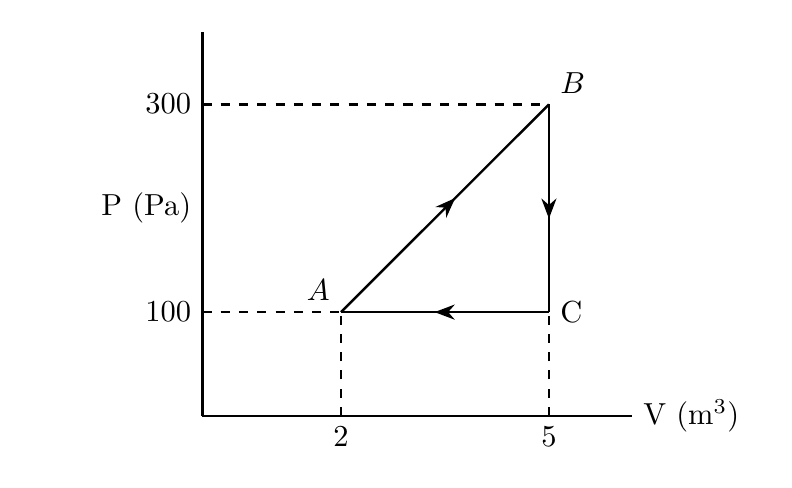
(See figure)
Theory · how these 7 PYQs are the same concept
For any closed path on a P–V diagram the net work equals the enclosed area; it is positive when the loop runs clockwise (V on the x-axis) and negative when anticlockwise. Since ΔU = 0 over a cycle, net heat absorbed equals this work. For a circle or ellipse use with the semi-axes in pressure and volume units. Reading the area under one side only, or ignoring the sign from the direction, is the trap.
How NTA asks it
Triangles or rectangles on P–V axes, a circular or elliptical cycle (answer in π J), heat absorbed in a cycle, or magnitude of heat exchanged for ABCA.
- 2026 (Unique PYQ): Unique PYQ: cycle ABC drawn as a triangle; total work done by the system = 300 J.
- 2025: Elliptical/circular cycle; work in ×10⁻¹ J using π = 3.14.
- 2025: Magnitude of heat exchanged in ABCA equals the enclosed area.
- 2024: Same area rule, asked as heat absorbed in the cycle (Q = W).
- 2023: Triangular cycle with given coordinates; total work; same enclosed area.
- 2021: Circular cycle on the diagram; heat absorbed = π r₁ r₂ in π J.
- 2019: Cycle CAB; sign from the anticlockwise direction matters.
Isobaric expansion: Q = W·γ/(γ − 1), ΔU = W/(γ − 1)
Asked 7 times (2019, 2021, 2022, 2024, 2026) • covers 6 similar PYQs
Reading and converting P–V, V–T and P–T graphs of processes
Asked 7 times (2019, 2020, 2021, 2022, 2023, 2024) • covers 6 similar PYQs
Isochoric heating: Q = ΔU = nC_vΔT
Asked 6 times (2021, 2022, 2024, 2026) • covers 5 similar PYQs
Isobaric heating with given ΔT: ΔU = nC_vΔT, W = nRΔT
Asked 6 times (2019, 2021, 2022, 2023, 2025, 2026) • covers 5 similar PYQs
First law and state variables: conceptual statements
Asked 6 times (2021, 2023, 2025) • covers 5 similar PYQs
Carnot engines in series: intermediate temperature and overall η
Asked 6 times (2019, 2020, 2021, 2022, 2025) • covers 5 similar PYQs
Match-the-list: process conditions (ΔQ, ΔU, ΔW, constant variable)
Asked 6 times (2020, 2021, 2023, 2025) • covers 5 similar PYQs
Adiabatic pressure–volume change: PV^γ = constant
Asked 6 times (2020, 2022, 2023, 2024, 2025) • covers 5 similar PYQs
Adiabatic process: qualitative statements
Asked 5 times (2020, 2023, 2025) • covers 4 similar PYQs
Adiabatic temperature change: TV^(γ−1) = constant
Asked 5 times (2020, 2021, 2022, 2025) • covers 4 similar PYQs
Carnot efficiency values and its limits
Asked 5 times (2021, 2022, 2023) • covers 4 similar PYQs
Carnot engine with heat and work: Q₁ = W/η, Q₂ = Q₁ T₂/T₁
Asked 5 times (2020, 2021, 2022, 2023) • covers 4 similar PYQs
First law in phase changes and liquids: ΔU = Q − PΔV
Asked 4 times (2023, 2025, 2026) • covers 3 similar PYQs
Work along an open path: area under the P–V curve
Asked 4 times (2022, 2023, 2024, 2025) • covers 3 similar PYQs
Adiabat versus isotherm: slopes and work compared
Asked 4 times (2022, 2024, 2025) • covers 3 similar PYQs
Adiabatic work depends only on temperature change
Asked 4 times (2021, 2022, 2025) • covers 3 similar PYQs
Finding γ or the exponent from an adiabatic relation
Asked 4 times (2019, 2021, 2023, 2024) • covers 3 similar PYQs
Path independence of ΔU: compare different paths and cycle legs
Asked 4 times (2019, 2022) • covers 3 similar PYQs
Cycles built from isothermal, isobaric, isochoric and adiabatic steps
Asked 3 times (2021, 2025) • covers 2 similar PYQs
Gas at fixed volume: P ∝ T (Gay-Lussac's law)
Asked 3 times (2025) • covers 2 similar PYQs
First-law bookkeeping with rates or given Q: ΔU = Q − W
Asked 3 times (2021, 2023, 2024) • covers 2 similar PYQs
Polytropic process PVˣ = const: W = nRΔT/(1 − x)
Asked 3 times (2021, 2024) • covers 2 similar PYQs
Molar heat capacity of a process: C = C_v + W/(nΔT)
Asked 3 times (2019, 2021, 2022) • covers 2 similar PYQs
Multi-step chains: adiabatic followed by isobaric or isothermal steps
Asked 3 times (2020, 2022) • covers 2 similar PYQs
Efficiency from heats, then the reservoir temperature
Asked 3 times (2021, 2022) • covers 2 similar PYQs
Refrigerator: COP = T₂/(T₁ − T₂) = Q₂/W
Asked 3 times (2020, 2021) • covers 2 similar PYQs
Cycle with a curved side: integrate P dV along the curve
Asked 2 times (2024, 2026) • covers 1 similar PYQ
Isothermal work and heat: W = Q = nRT ln(V₂/V₁)
Asked 2 times (2021, 2025) • covers 1 similar PYQ
Internal energy of an ideal gas: U = nC_vT = PV/(γ − 1)
Asked 2 times (2022, 2025) • covers 1 similar PYQ
Entropy change: ΔS = ∫dQ/T and irreversible mixing
Asked 2 times (2021, 2025) • covers 1 similar PYQ
Temperature along a given P–V relation: T = PV/nR at each end
Asked 2 times (2019, 2021) • covers 1 similar PYQ
Efficiency of a non-Carnot cycle: η = W_net / Q_absorbed
Asked 2 times (2020) • covers 1 similar PYQ