Center of Mass Momentum and Collision
103 PYQs → 33 unique concepts, 70 similar PYQs. The first 3 are free.
JEE Main 2019 · JEE Main 09 Apr 2019 Shift-I
Head-on elastic collision, target at rest: v₁ = (m₁ − m₂)u/(m₁ + m₂)
CollisionsAsked 7 times (2019, 2021, 2023, 2025) • Solving this covers 6 similar PYQs
A body of mass 2 kg makes an eleastic collision with a second body at rest and continues to move in the original direction but with one fourth of its original speed. What is the mass of the second body ?
Theory · how these 7 PYQs are the same concept
With the target at rest, a head-on elastic collision gives and ; equivalently, velocity of separation equals velocity of approach. The projectile rebounds if it is lighter and keeps going if it is heavier, so the sign of matters. A stated energy loss must first be turned into a speed ratio ().
How NTA asks it
The projectile's final speed is given as a fraction of the initial, as an energy loss, or as rebound angle of a pendulum, and the unknown mass, initial speed, mass ratio or centre-of-mass speed is asked.
- 2019 (Unique PYQ): A 2 kg body continues forward with one fourth of its speed; asks the mass of the second body.
- 2025: Bob released from 60° hits a bob of half the mass; speed from energy, then the v₁ formula.
- 2023: 1 kg rebounds at 2 m/s from a 3 kg body; the formula is used backwards for the initial speed.
- 2021: Same collision as 092 with a number for the speed; asks the centre-of-mass speed after finding m₂.
- 2021: Both leave with equal and opposite speeds; equating |v₁| and v₂ gives m₂ : m₁ = 3.
- 2019: Alpha particle scattered back after losing 64% of its KE; speed ratio 0.6 gives the nuclear mass.
- 2019: Pendulum bob rebounds from block M to angle θ₁; speeds ∝ angles, same v₁ formula gives M.
JEE Main 2020 · JEE Main 07 Jan 2020 Shift-I
Centre of mass of point masses: r_cm = Σm·r / Σm (and a_cm = Σm·a / Σm)
Centre of MassAsked 7 times (2019, 2020, 2022, 2024) • Solving this covers 6 similar PYQs
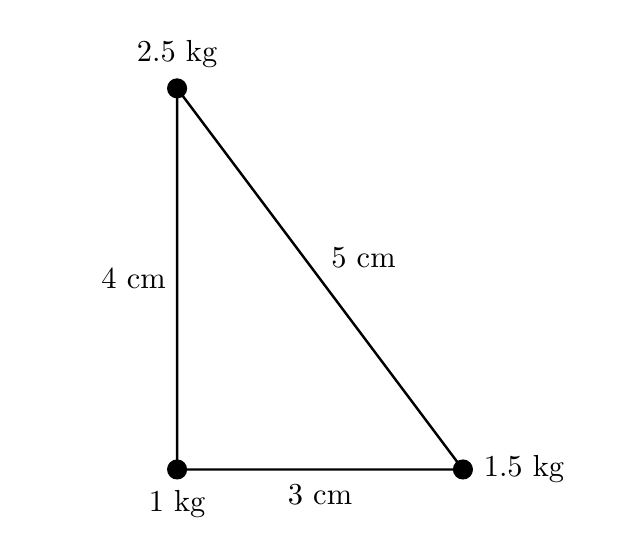
Three point masses 1 kg, 1.5 kg and 2.5 kg are placed at the vertices of a triangle with sides 3 cm, 4 cm and 5 cm as shown in the figure. The location of centre of mass with respect to 1 kg mass is:
(See figure)
(See figure)
Theory · how these 7 PYQs are the same concept
The centre of mass of discrete particles is the mass-weighted average of their positions, taken one coordinate at a time: . The same weighting gives the velocity and acceleration of the centre of mass. Put the origin at one of the masses so its term drops out. Typical slips: forgetting to divide by the total mass, or using the centroid of the triangle when the masses are unequal.
How NTA asks it
Masses at the corners of a right or equilateral triangle, or given by position vectors; asked for coordinates, for in a fill-in form, or (once) for the acceleration of the centre of mass of four masses on a square.
- 2020 (Unique PYQ): Asks the CM of 1, 1.5 and 2.5 kg at the corners of a 3-4-5 triangle, measured from the 1 kg mass.
- 2024: Equal masses on a right triangle with 4 m legs; asks the magnitude of r_cm as 4√2/x.
- 2022: Two masses given by 3-D position vectors; find |r_cm| and match it with a vector of equal length.
- 2022: Same as 004 with 3 m legs; answer written as √x.
- 2020: Same 1, 1.5, 2.5 kg triangle as 020 from another shift; same weighted average.
- 2019: Unequal masses 50, 100, 150 g on an equilateral triangle; needs the √3/2 height for y.
- 2019: Same weighted mean applied to accelerations: a_cm of masses m, 2m, 3m, 4m on a square.
JEE Main 2020 · JEE Main 08 Jan 2020 Shift-I
Centre of mass of a body built from simple pieces (L-laminae, bent rods, cut sheets)
Centre of MassAsked 6 times (2019, 2020, 2024, 2025) • Solving this covers 5 similar PYQs
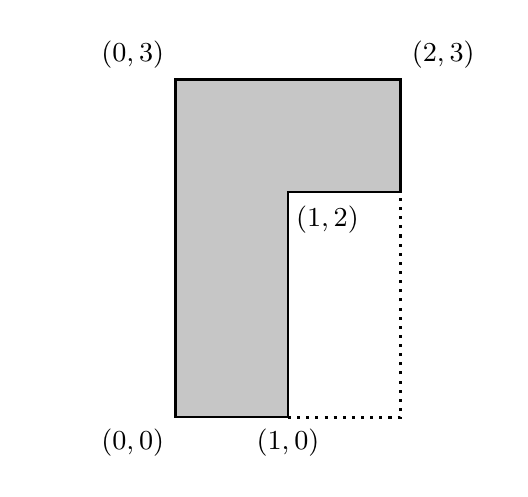
Find the co-ordinates of centre of mass of the lamina, shown in figure.
(See figure)
(See figure)
Theory · how these 6 PYQs are the same concept
Break the body into rectangles or straight rods whose centres are obvious, replace each by a point mass at its centre (mass ∝ area for a uniform sheet, ∝ length for a uniform rod) and apply . A cut-out rectangle is handled as a negative mass. The mistakes are in the bookkeeping: wrong centre for a piece, or weighting by side length when it should be area.
How NTA asks it
A figure of an L-shaped or stepped lamina, a rectangular sheet with a quarter or a square removed, or a rod bent at right angles; asked for the CM coordinates or the ratio x/y.
- 2020 (Unique PYQ): Asks the CM coordinates of an L-shaped lamina split into two rectangular strips.
- 2025: Rod of length 5L bent at a right angle into 2L and 3L arms; same weighted mean of midpoints.
- 2024: 3×2 plate with a unit square removed, treated as negative area; asks the ratio x/y as n/9.
- 2020: Another L-shaped lamina (1×3 strip plus 1×1 square); same split-and-average.
- 2019: Rectangular sheet with one quarter cut off; subtract mass M/4 at (3a/4, 3b/4).
- 2019: Pieces are rods (2L, L, L) of a bent bar; weights are lengths instead of areas.
Break-up in a plane: fragment velocity from vector momentum conservation
Asked 5 times (2019, 2021, 2022, 2026) • covers 4 similar PYQs
Centre of mass after cutting a hole or cavity: treat the removed part as negative mass
Asked 5 times (2020, 2021, 2025) • covers 4 similar PYQs
Impulse on a rebounding body: Δp = m(v + u), average force F = Δp/Δt
Asked 5 times (2022, 2023, 2024) • covers 4 similar PYQs
Kinetic energy lost in a perfectly inelastic collision on a line (single or successive)
Asked 4 times (2019, 2020, 2022, 2026) • covers 3 similar PYQs
Centre of mass by integration when density varies: x_cm = ∫x·dm / ∫dm
Asked 4 times (2020, 2022, 2025) • covers 3 similar PYQs
Momentum and kinetic energy of one body: K = p²/2m, p = √(2mK)
Asked 4 times (2023, 2024) • covers 3 similar PYQs
Force from a steady stream of bullets or fluid: F = (dm/dt)·Δv
Asked 4 times (2019, 2022, 2023) • covers 3 similar PYQs
Collision followed by projectile motion: momentum at impact, then kinematics of the fall
Asked 4 times (2020, 2023) • covers 3 similar PYQs
Elastic collision in a plane: momentum components plus kinetic-energy conservation
Asked 4 times (2020) • covers 3 similar PYQs
Maximum height or compression: both bodies share a common velocity, then use energy
Asked 3 times (2019, 2021, 2025) • covers 2 similar PYQs
Impulse–momentum theorem in one go: J = Δp (catching, firing, projectile)
Asked 3 times (2021, 2023, 2024) • covers 2 similar PYQs
Sticking together in one dimension: common velocity v = (m₁u₁ + m₂u₂)/(m₁ + m₂)
Asked 3 times (2022, 2023, 2024) • covers 2 similar PYQs
Two bodies separating from rest: m₁v₁ = m₂v₂
Asked 3 times (2019, 2023) • covers 2 similar PYQs
Elastic collision: speed and energy given to the struck body, v₂ = 2m₁u/(m₁ + m₂)
Asked 3 times (2021, 2022) • covers 2 similar PYQs
Standard CM results: semicircular wire 2R/π, quarter disc 4R/3π, solid hemisphere 3R/8
Asked 3 times (2020, 2021) • covers 2 similar PYQs
Oblique collision with the directions given: resolve momentum along and across the line
Asked 3 times (2019, 2021) • covers 2 similar PYQs
Perfectly inelastic collision in a plane: add the momenta as vectors
Asked 3 times (2020) • covers 2 similar PYQs
Bodies meeting on a vertical line and sticking: meeting point, momentum, then free fall
Asked 3 times (2019, 2020) • covers 2 similar PYQs
Elastic collision of equal masses on a line: velocities are exchanged
Asked 2 times (2023, 2025) • covers 1 similar PYQ
Keeping the centre of mass fixed: m₁Δx₁ = m₂Δx₂
Asked 2 times (2022, 2024) • covers 1 similar PYQ
Ballistic pendulum: momentum at impact, then energy for the swing (h = V²/2g)
Asked 2 times (2021, 2024) • covers 1 similar PYQ
Bullet strikes a pendulum bob that must complete a vertical circle (u = √(5gL))
Asked 2 times (2021, 2022) • covers 1 similar PYQ
Momentum conservation alone fixes the unknown velocity (nature of collision not needed)
Asked 2 times (2019, 2020) • covers 1 similar PYQ
Kinetic energy of a system = KE of centre of mass + KE about the centre of mass
Asked in 2026
Balancing a rod on a knife edge: weight acts at the centre of mass (torque balance)
Asked in 2025
Impulse as the area under a force–time graph
Asked in 2023
Coefficient of restitution with the floor: rebound height h′ = e²h
Asked in 2023
Elastic bounces off a wall under a constant force: period = 2 × time to reach the wall
Asked in 2021
Particle hitting the end of a free rod: linear momentum, angular momentum and energy
Asked in 2021
Variable-mass body with no external force: M·dv/dt = −v·dM/dt
Asked in 2020