Work Power Energy
132 PYQs → 41 unique concepts, 91 similar PYQs. The first 3 are free.
JEE Main 2024 · JEE Main 30 Jan 2024 Shift-I
Speed from a vertical drop on a smooth path: $\frac12mv^2=mg\Delta h$
Work-Energy Theorem and Potential EnergyAsked 8 times (2020, 2021, 2022, 2024) • Solving this covers 7 similar PYQs
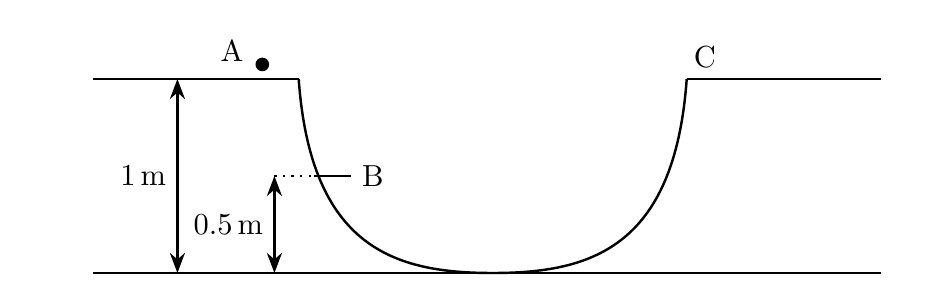
A particle is placed at the point A of a frictionless track ABC as shown in figure. It is gently pushed toward right. The speed of the particle when it reaches the point B is : ( Take ).
(See figure)
(See figure)
Theory · how these 8 PYQs are the same concept
On a frictionless track, or for a pendulum bob, the normal force and the tension do no work, so the gain in kinetic energy equals the loss of potential energy: from rest. Only the vertical drop matters, not the shape or length of the path. For a pendulum of length l released at angle , . On a circular arc, read the height from the geometry of the figure.
How NTA asks it
A track drawn in a figure with heights of A and B (speed or KE asked), a pendulum pulled to 60°, a slide along a vertical circular arc, or the launch speed that just reaches a given height.
- 2024 (Unique PYQ): Unique PYQ: particle pushed gently from A at 1 m to B at 0.5 m on a smooth track; find the speed.
- 2024: Slide along a vertical circle of R = 14 m; the drop is $R(1+1/\sqrt2)$ from the figure.
- 2022: Reversed: block just reaches B at 10 m, so $v_0=\sqrt{2gh}$; then times on both inclines are added.
- 2022: Symbolic: block dropped from A to B through $y_0$, so $K=mgy_0$.
- 2022: Pendulum of 250 cm released at 60°: drop $l(1-\cos\theta)$ gives the maximum speed.
- 2021: Same track question with heights 10 m and 5 m; speed 10 m/s.
- 2020: Kinetic energy asked instead of speed for a 1 kg particle dropping from 2 m to 1 m.
- 2020: Track followed by free flight to a highest point at 1 m; still only the drop of 1 m matters.
JEE Main 2024 · JEE Main 09 Apr 2024 Shift-II
Work by a variable force along a line: $W=\int F(x)\,dx$
Work Done by a ForceAsked 6 times (2021, 2023, 2024, 2025) • Solving this covers 5 similar PYQs
A force N displaces a body from m to m. Work done by this force is ______ J.
Theory · how these 6 PYQs are the same concept
When the force changes with position, work is the integral of force over the path: . For a polynomial force integrate term by term and put the limits. Multiplying the force at one end (or an average of the two end values) by the distance is wrong unless F is linear. Watch the lower limit: it is not always zero.
How NTA asks it
A polynomial F(x) or F(y) with two limits and the work asked as an integer; once reversed, with the work given and a coefficient of the force law asked.
- 2024 (Unique PYQ): Unique PYQ: $F=3x^2+2x-5$ from x = 2 m to 4 m; integrate term by term.
- 2025: Reversed: the work over 1 m is given as 5 J and the coefficient $\beta$ of $x^2$ is asked.
- 2023: Linear force $F=5x$ between 2 m and 4 m; same integral.
- 2023: $F=2+3x$ from 0 to 4 m; same integral with a constant term.
- 2023: Force along y, $5+3y^2$, from 2 m to 5 m; same method on the y-axis.
- 2021: $F=5y+20$ from 0 to 10 m; same integral.
JEE Main 2021 · JEE Main 27 Jul 2021 Shift-II
Motion under constant power: $v\propto t^{1/2}$, $s\propto t^{3/2}$
PowerAsked 6 times (2020, 2021, 2023, 2024) • Solving this covers 5 similar PYQs
An automobile of mass '' accelerates starting from origin and initially at rest, while the engine supplies constant power . The position is given as a function of time by:
Theory · how these 6 PYQs are the same concept
If an engine delivers constant power P to a body starting from rest, the energy supplied in time t is all kinetic: , so . Integrating, . The acceleration is not constant (it falls as ), so cannot be used.
How NTA asks it
Asked for the power of t in the displacement, for the full expression x(t), or for the distance in a given time with numbers for m and P.
- 2021 (Unique PYQ): Unique PYQ: full expression for x(t) of a car of mass m with constant power P.
- 2024: Only the proportionality is asked: displacement goes as $t^{3/2}$.
- 2023: Numbers: 2 kg, 4 s, distance written as $\frac13\alpha^2\sqrt P$; find $\alpha$.
- 2021: Machine delivering constant power; same $t^{3/2}$ result.
- 2021: Box towed by a constant power machine; same proportionality again.
- 2020: Numbers: 2 kg, 1 W, 9 s; integrate $v=\sqrt t$ for the distance.
Work–energy theorem from a kinematic relation $x(t)$ or $v(x)$
Asked 5 times (2019, 2022, 2024, 2026) • covers 4 similar PYQs
Fractional loss of kinetic energy from a speed or height ratio ($K\propto v^2$)
Asked 5 times (2021, 2023, 2024) • covers 4 similar PYQs
Power of a lift motor at constant speed: $P=(mg+f)v$
Asked 5 times (2020, 2023) • covers 4 similar PYQs
Vertical circle on a string: $v_{top}^2=gR$, $v_{bottom}^2=v_{top}^2+4gR$
Asked 4 times (2024, 2025, 2026) • covers 3 similar PYQs
Work by a constant force: $W=\vec F\cdot\vec d=Fd\cos\theta$
Asked 4 times (2019, 2021, 2023, 2025) • covers 3 similar PYQs
Work–energy theorem with a position-dependent force: $\Delta K=\int F\,dx$
Asked 4 times (2022, 2023, 2024, 2025) • covers 3 similar PYQs
Momentum–kinetic energy link at equal K or equal p: $K=\frac{p^2}{2m}$
Asked 4 times (2021, 2022, 2024) • covers 3 similar PYQs
Mechanical energy lost to friction or air drag: $W_{nc}=\Delta(K+U)$
Asked 4 times (2021, 2023, 2024) • covers 3 similar PYQs
Break-up or recoil: momentum conservation and the share of kinetic energy
Asked 4 times (2021, 2024) • covers 3 similar PYQs
Stopping distance under a constant retarding force ($\Delta K=-fs$)
Asked 4 times (2022, 2023) • covers 3 similar PYQs
Kinetic energy converted to spring energy on a level surface: $\Delta K=\frac12kx^2$
Asked 4 times (2021, 2022) • covers 3 similar PYQs
Force from potential energy, $F=-\frac{dU}{dx}$, and reading a $U(x)$ graph
Asked 3 times (2021, 2024, 2026) • covers 2 similar PYQs
Tension in a vertical circle: $T=\frac{mv^2}{r}+mg\cos\theta$
Asked 3 times (2021, 2022, 2026) • covers 2 similar PYQs
Conservative forces: path-independent work and potential energy
Asked 3 times (2025, 2026) • covers 2 similar PYQs
Work by a position-dependent force in a plane: $W=\int F_x\,dx+\int F_y\,dy$
Asked 3 times (2020, 2022, 2025) • covers 2 similar PYQs
Energy conservation with gravity and a spring together
Asked 3 times (2019, 2022, 2025) • covers 2 similar PYQs
Instantaneous power $P=Fv$ of a force on an accelerating body
Asked 3 times (2022, 2023, 2025) • covers 2 similar PYQs
Work by or against friction at steady speed: $W=\mu Ns$
Asked 3 times (2023, 2024, 2025) • covers 2 similar PYQs
Kinetic and potential energy during free fall and projectile flight
Asked 3 times (2023, 2025) • covers 2 similar PYQs
Spring–block system: total mechanical energy fixed by the extreme position
Asked 3 times (2022, 2023, 2025) • covers 2 similar PYQs
Power of a time-dependent force: integrate for $\vec v$, then $P=\vec F\cdot\vec v$
Asked 3 times (2023, 2024, 2025) • covers 2 similar PYQs
Sign of work and work against gravity ($\pm mgh$, independent of path)
Asked 3 times (2021, 2023, 2024) • covers 2 similar PYQs
Work–energy theorem on an incline with friction
Asked 3 times (2020, 2024) • covers 2 similar PYQs
Percentage change in kinetic energy when momentum changes ($K\propto p^2$)
Asked 3 times (2021, 2022, 2023) • covers 2 similar PYQs
Constant force acting for a time or distance: kinetic energy gained
Asked 3 times (2020, 2023) • covers 2 similar PYQs
Equilibrium separation from a two-term potential: set $\frac{dU}{dr}=0$
Asked 3 times (2020, 2021, 2022) • covers 2 similar PYQs
Work as the area under a force–displacement graph
Asked 3 times (2019, 2020, 2022) • covers 2 similar PYQs
Conveyor belt with falling sand: $F=v\frac{dm}{dt}$, $P=v^2\frac{dm}{dt}$
Asked 2 times (2022, 2025) • covers 1 similar PYQ
Speed at other points of a vertical circle from a given speed: $v^2=u^2-2gh$
Asked 2 times (2022, 2025) • covers 1 similar PYQ
Energy conservation for a rolling body: $K=\frac12mv^2+\frac12I\omega^2$
Asked 2 times (2022, 2023) • covers 1 similar PYQ
Circular orbit in a given potential: $\frac{mv^2}{r}=\left|\frac{dU}{dr}\right|$
Asked 2 times (2021, 2023) • covers 1 similar PYQ
Normal reaction on a smooth curved surface: energy plus radial equation
Asked 2 times (2021, 2022) • covers 1 similar PYQ
Hanging chain or cable: work and energy from the centre of mass of the hanging part
Asked 2 times (2019, 2021) • covers 1 similar PYQ
Bead on a dipping frictionless path vs a straight path: who arrives first
Asked in 2026
Energy balance for a gas pushing a piston hung from a non-linear spring ($F=-kx^3$)
Asked in 2025
Power of a motor raising water: $P=\frac{mgh}{t}$
Asked in 2023
Work done by the normal reaction on an accelerating platform
Asked in 2019
Work done by a person standing up on a swing at its lowest point
Asked in 2019