Laws of Motion
115 PYQs → 35 unique concepts, 80 similar PYQs. The first 3 are free.
JEE Main 2021 · JEE Main 26 Feb 2021 Shift-I
Apparent weight in vertical acceleration: N or T = m(g ± a)
Newton's Laws and Free Body DiagramsAsked 7 times (2021, 2022, 2023, 2024) • Solving this covers 6 similar PYQs
A person standing on a spring balance inside a stationary lift measures 60 kg. The weight of that person if the lift descends with uniform downward acceleration of will be ______ N. []
Theory · how these 7 PYQs are the same concept
For a body accelerating vertically, apply along the vertical. With upward acceleration the supporting force (normal reaction, scale reading or rope tension) is ; with downward acceleration it is ; at constant velocity it is , whichever way the lift moves. What matters is the direction of acceleration, not of velocity. The same equation applies to a block and load sinking into a floor or a climber on a rope.
How NTA asks it
Asked as a scale reading in a descending lift, the acceleration when the floor force is a fraction of the weight, 'when does a person feel lighter', true/false statements on elevators, reaction of a yielding floor, and whether a rope breaks for a climbing monkey.
- 2021 (Unique PYQ): Unique PYQ: 60 kg person in a lift accelerating down at 1.8 m/s²; reading is m(g − a) = 492 N.
- 2024: Block plus cylinder (30 kg) sink at 0.1 m/s²; floor reaction is m(g − a).
- 2023: Two statements: uniform speed needs tension = weight (true); speeding up downward gives less than weight.
- 2022: Monkey on a rope: T = m(g − a) going down, m(g + a) going up; compare with the breaking tension.
- 2022: Reverse: floor force is one-fourth of the weight, so a = 3g/4 downward.
- 2022: Conceptual: weight loss is felt when the lift accelerates downward.
- 2021: Same sinking-floor idea with a 70 kg stack and a = 0.2 m/s².
JEE Main 2024 · JEE Main 31 Jan 2024 Shift-II
Block held on a rough incline: push up needs mg sinθ + f, holding needs mg sinθ − f
FrictionAsked 6 times (2019, 2022, 2023, 2024, 2026) • Solving this covers 5 similar PYQs
A block of mass kg is placed on a rough inclined surface as shown in the figure.
If is the force required to just move the block up the inclined plane and is the force required to just prevent the block from sliding down, then the value of is : [Use ]
(See figure)
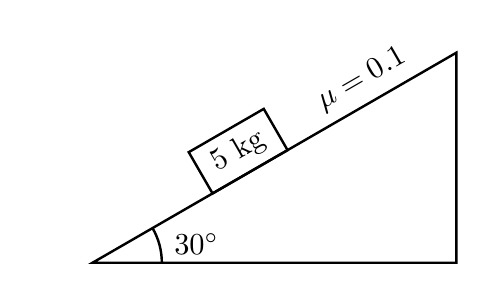
If is the force required to just move the block up the inclined plane and is the force required to just prevent the block from sliding down, then the value of is : [Use ]
(See figure)
Theory · how these 6 PYQs are the same concept
On an incline the weight component acts down the plane and limiting friction is , directed against the impending motion. To just move the block up, ; to just stop it sliding down, . Their difference is . At constant velocity the net force is zero, so the plane's total contact force equals . The trap is the direction of friction, which flips between the two cases.
How NTA asks it
Asked as F1 − F2, as μ from the ratio F1/F2 or from the maximum up and down forces that keep the block at rest, as the minimum holding force with another force present, as the force for uniform sliding, and as the contact force.
- 2024 (Unique PYQ): Unique PYQ: 5 kg block; difference between the force to push it up and the force to hold it equals 2f.
- 2026: Here friction exceeds mg sinθ, so an extra force down the plane is needed for uniform sliding.
- 2023: Ratio form at 45°: F1 = 2F2 gives μ = 1/3.
- 2022: Uniform sliding: normal force and friction together balance the weight, so contact force is Mg.
- 2019: Two limiting forces (2 N down, 10 N up) keep the block at rest; add and subtract to get μ.
- 2019: Minimum force P up the plane with an extra 3 N acting down; friction helps hold the block.
JEE Main 2024 · JEE Main 30 Jan 2024 Shift-II
Connected bodies on smooth surfaces: system acceleration, then tension from one body
Constraint Motion, Pulleys and Pseudo ForceAsked 6 times (2022, 2023, 2024) • Solving this covers 5 similar PYQs
Three blocks A, B and C are pulled on a horizontal smooth surface by a force of N as shown in figure
The tensions and in the string are respectively:
(See figure)

The tensions and in the string are respectively:
(See figure)
Theory · how these 6 PYQs are the same concept
For bodies joined by light strings, first treat everything that moves together as one system: . Then isolate the part beyond the string you care about: the tension must accelerate only the mass it pulls (and support its weight if vertical). On inclines the driving force of each block is . The trap is using the whole applied force as the tension, or forgetting gravity for hanging parts.
How NTA asks it
Asked for tensions in a row of blocks pulled on a table, in a vertical chain of blocks accelerating upward, between balls slipping off a table, on a double incline, for a hanging mass pulled via a block on ice, and as the force F on a cart system.
- 2024 (Unique PYQ): Unique PYQ: three blocks pulled by 80 N on a smooth surface; find T1 and T2.
- 2024: Vertical version: three hanging blocks accelerate up at 2 m/s2; top rope carries all 20 kg.
- 2023: Double smooth incline (60° and 30°): driving force is the difference of mg sinθ terms; tension asked.
- 2022: Three-mass cart: tension from m2's upward acceleration, then F from the horizontal motion of all parts.
- 2022: Block of 4M on ice pulled by 2Mg with M hanging; system acceleration g/5, then tension on M.
- 2022: Ten balls slipping over a table edge: 6 hanging drive all 10; tension between 7th and 8th pulls 3 balls.
Force applied at an angle on a rough floor: N = mg ∓ F sinθ changes friction
Asked 6 times (2019, 2021, 2023) • covers 5 similar PYQs
Impulse and average force: J = Δp = F_avg·Δt; force is the slope of p–t
Asked 5 times (2021, 2022, 2023, 2024) • covers 4 similar PYQs
Horizontal force at a point of a hanging rope: F = mg tanθ
Asked 5 times (2019, 2020, 2022, 2024) • covers 4 similar PYQs
Atwood machine: a = (m₂ − m₁)g/(m₁ + m₂)
Asked 5 times (2022, 2024) • covers 4 similar PYQs
Time-dependent force: Δp = ∫F dt, then integrate again for position
Asked 4 times (2019, 2021, 2024, 2026) • covers 3 similar PYQs
Limiting static friction holding a body: set f = μN equal to the force trying to move it
Asked 4 times (2021, 2022, 2026) • covers 3 similar PYQs
Body hanging from two inclined strings: resolve tensions horizontally and vertically
Asked 4 times (2023, 2025, 2026) • covers 3 similar PYQs
Sliding on a rough incline: a = g(sinθ − μ cosθ), friction = μ mg cosθ
Asked 4 times (2021, 2023, 2024, 2025) • covers 3 similar PYQs
Comparing sliding times: t ∝ 1/√a for smooth vs rough incline or ascent vs descent
Asked 4 times (2021, 2023, 2024) • covers 3 similar PYQs
Limiting slope for no slipping: tan θ = μ (angle of repose), including curved surfaces
Asked 4 times (2020, 2021, 2024) • covers 3 similar PYQs
Kinetic friction on a level surface: f = μ mg, deceleration μg
Asked 4 times (2022, 2023, 2024) • covers 3 similar PYQs
Two stacked blocks moving together: common acceleration limited by a = μ_s g
Asked 4 times (2019, 2021, 2022) • covers 3 similar PYQs
Motion with a velocity-dependent resistive force: set up and integrate dv/dt
Asked 3 times (2019, 2020, 2026) • covers 2 similar PYQs
Accelerating wedge or vehicle: work in its frame with pseudo force −ma₀
Asked 3 times (2021, 2026) • covers 2 similar PYQs
Hooke's law for springs and strings: T = k(l − l₀); k ∝ 1/length
Asked 3 times (2025, 2026) • covers 2 similar PYQs
Newton's second law with vectors: F = m·a, a from differentiating r(t) or v(t)
Asked 3 times (2023, 2024) • covers 2 similar PYQs
String-connected system with kinetic friction: a = (driving force − friction)/total mass
Asked 3 times (2022, 2024) • covers 2 similar PYQs
Movable pulley constraint: string-length condition links accelerations (a and 2a)
Asked 3 times (2021, 2022, 2024) • covers 2 similar PYQs
Constant force found from kinematics: get a from v² = u² + 2as or v = u + at, then F = ma
Asked 3 times (2021, 2023) • covers 2 similar PYQs
Equilibrium of concurrent forces: ΣFx = 0 and ΣFy = 0; resolving a force along given lines
Asked 3 times (2021, 2022) • covers 2 similar PYQs
Equilibrium or uniform motion on a smooth incline: balance mg sinθ along the plane
Asked 3 times (2021, 2022) • covers 2 similar PYQs
Constant force from rest: r = ½(F/m)t² for each component
Asked 3 times (2021, 2022) • covers 2 similar PYQs
Motion on a smooth incline: a = g sinθ along the plane
Asked 2 times (2022, 2026) • covers 1 similar PYQ
Force from velocity as a function of position: a = v dv/dx
Asked 2 times (2023, 2025) • covers 1 similar PYQ
Thrust from ejected mass: F = v_rel·(dm/dt)
Asked 2 times (2021, 2022) • covers 1 similar PYQ
Pulling a block out of a stack: add friction from every sliding interface
Asked in 2026
Balloon with constant upthrust: release mass to raise acceleration
Asked in 2025
Force by a support = total weight hanging from it (system as one body)
Asked in 2024
Laws of friction: independent of contact area, depends on the pair of materials
Asked in 2024
Inertia (Newton's first law): a body keeps its state of motion until a force changes it
Asked in 2023
Two masses joined by a spring: the spring force acts equally and oppositely on both
Asked in 2021
Velocity-dependent force F = k(v_y i + v_x j): testing which quantity stays constant
Asked in 2020