Motion in One Dimension
93 PYQs → 28 unique concepts, 65 similar PYQs. The first 3 are free.
JEE Main 2023 · JEE Main 11 Apr 2023 Shift-I
Area under v-t graph: displacement (signed) and distance (absolute)
Graphs of MotionAsked 8 times (2019, 2020, 2023, 2025) • Solving this covers 7 similar PYQs
From the graph shown, the ratio of distance to displacement in s of motion is:
(See figure)
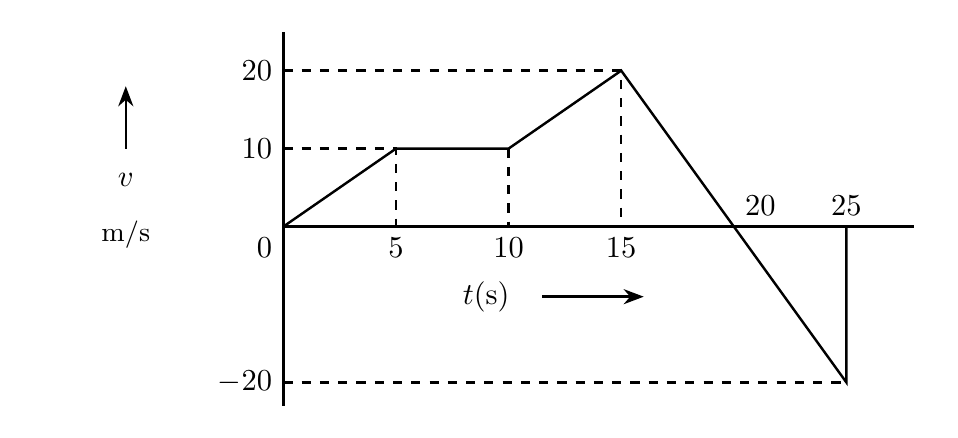
(See figure)
Theory · how these 8 PYQs are the same concept
The signed area under a v-t graph is the displacement; adding the magnitudes of the areas above and below the axis gives the distance. The area under an a-t graph is the change in velocity. Break the graph into triangles and trapezia; find where it crosses the axis by similar triangles. Trap: calling the signed area the distance when the graph dips below zero.
How NTA asks it
Distance or displacement over a time from a graph, their ratio, position at t = 5 s, distance in km for an airplane, or statement form on what the areas mean.
- 2023 (Unique PYQ): Unique PYQ: v-t graph dips below axis after 20 s; ratio distance/displacement in 25 s.
- 2025: Velocity keeps its sign, so distance equals the area from 0 to 4 s.
- 2025: Trapezium plus rectangle; distance of an airplane in km.
- 2023: Statement form: v-t area is displacement (not distance); a-t area is change in velocity.
- 2023: Same split of areas; asks displacement/distance from 0 to 10 s.
- 2020: Same method; crossing point S at 13/3 s, total distance in 6 s.
- 2020: Speed-time graph: area directly gives distance in 5 s.
- 2019: All area above axis; asks position at 5 s starting from origin.
JEE Main 2023 · JEE Main 30 Jan 2023 Shift-I
Average speed over segments: total distance / total time
Kinematics in a Straight LineAsked 7 times (2022, 2023, 2025) • Solving this covers 6 similar PYQs
A horse rider covers half the distance with 5 m/s speed. The remaining part of the distance was travelled with speed 10 m/s for half the time and with speed 15 m/s for other half of the time. The mean speed of the rider averaged over the whole time of motion is m/s. The value of is
Theory · how these 7 PYQs are the same concept
Average speed is total distance divided by total time, never the plain mean of speeds. For equal distances at it is the harmonic mean ; for three equal parts . For equal times the arithmetic mean applies. Unequal parts: add . Trap: averaging speeds when distances, not times, are equal.
How NTA asks it
Two or three equal distances at given speeds (symbolic or numeric), a figure with segment speeds, unequal parts with v2 unknown, or a mix of equal-distance and equal-time halves.
- 2023 (Unique PYQ): Unique PYQ: half distance at 5, rest split in equal times at 10 and 15; mean speed x/7.
- 2025: Unequal parts x and 1.5x; average given, v2 unknown; same total-time method.
- 2023: Same equal-distance case asked as a relation 2/v = 1/v1 + 1/v2.
- 2023: Three equal segments from a figure; harmonic-type mean of three speeds.
- 2023: Same equal-distance case with numbers 3 and 5 km/h.
- 2023: Plain equal-distance case; asks the symbolic harmonic mean.
- 2022: Three equal thirds with v2 = 2v1, v3 = 3v1; numeric value.
JEE Main 2024 · JEE Main 29 Jan 2024 Shift-II
Second derivative of $x(t)$: velocity when acceleration is zero, sign checks
Kinematics in a Straight LineAsked 6 times (2019, 2022, 2024, 2025, 2026) • Solving this covers 5 similar PYQs
A particle is moving in a straight line. The variation of position '' as a function of time '' is given as m. The velocity of the body when its acceleration becomes zero is :
Theory · how these 6 PYQs are the same concept
From a cubic , is quadratic and is linear. Setting gives the instant of extreme velocity; put that time back into . Turning points are where ; equal velocities of two bodies come from equating their derivatives. Trap: substituting the time into instead of , or forgetting that a quadratic has constant .
How NTA asks it
Velocity at the instant of zero acceleration for numeric or symbolic cubics, statement checks on a cubic path, the time two buses have equal velocity, or acceleration of a quadratic law.
- 2024 (Unique PYQ): Unique PYQ: x = t^3 - 6t^2 + 20t + 15; velocity when a = 0.
- 2026: Statement form on x = 4t^3 - 3t: return time, turning point, sign of a.
- 2025: Quadratic in t with constants c0, c; second derivative is the constant 2(c + c0).
- 2024: Same steps with x = -3t^3 + 18t^2 + 16t; a = 0 at t = 2 s, then v.
- 2022: Two position laws; equate their first derivatives for the time of equal velocity.
- 2019: Same steps with symbolic a, b, c; answer a + b^2/3c.
Stopping and penetration distance: $v^2=u^2-2as$
Asked 6 times (2019, 2021, 2022, 2023, 2024) • covers 5 similar PYQs
Uniform acceleration with $s=ut+\tfrac12at^2$ and ratios from rest
Asked 5 times (2019, 2022, 2023, 2024) • covers 4 similar PYQs
Acceleration from velocity as a function of position: $a=v\,dv/dx$
Asked 5 times (2019, 2021, 2022, 2023, 2024) • covers 4 similar PYQs
From a v-x or $v^2$-x graph to acceleration: $a=v\,dv/dx$
Asked 4 times (2021, 2026) • covers 3 similar PYQs
Reading slopes: v from x-t, a from v-t
Asked 4 times (2021, 2023, 2025) • covers 3 similar PYQs
Free fall from rest: distances and times over parts of the fall
Asked 4 times (2020, 2022, 2024) • covers 3 similar PYQs
Instantaneous velocity by differentiating $x(t)$: $v=dx/dt$
Asked 4 times (2022, 2023) • covers 3 similar PYQs
Projection from a height or a moving platform: signed $y=ut-\tfrac12gt^2$
Asked 4 times (2020, 2021, 2022) • covers 3 similar PYQs
Two bodies launched at different times meet: equate positions
Asked 4 times (2021, 2022) • covers 3 similar PYQs
Two-phase motion: accelerate then decelerate (peak speed shared)
Asked 3 times (2021, 2026) • covers 2 similar PYQs
Drops falling from a tap at equal intervals
Asked 3 times (2021, 2026) • covers 2 similar PYQs
Motion graph from the force law: viscous drag, impact, constant power
Asked 3 times (2020, 2022, 2024) • covers 2 similar PYQs
Vertical throw: velocity at a time, zero at the top, time of rise $u/g$
Asked 3 times (2022, 2023) • covers 2 similar PYQs
Distance versus displacement on a circular path
Asked 2 times (2022, 2025) • covers 1 similar PYQ
Time given as a function of position $t=\alpha x^2+\beta x$: $a=-2\alpha v^3$
Asked 2 times (2021, 2024) • covers 1 similar PYQ
Bouncing ball: impact and rebound speeds from heights
Asked 2 times (2021, 2023) • covers 1 similar PYQ
Times at the same height going up and down
Asked 2 times (2021, 2022) • covers 1 similar PYQ
Displacement by integrating $v(t)$
Asked 2 times (2021) • covers 1 similar PYQ
Graph shapes for constant acceleration: a flat, v linear, x parabolic
Asked 2 times (2019, 2021) • covers 1 similar PYQ
Implicit law $x^2=at^2+2bt+c$: acceleration $\propto x^{-3}$
Asked 2 times (2020) • covers 1 similar PYQ
Velocity or momentum against height under gravity: parabolic curve
Asked 2 times (2019, 2020) • covers 1 similar PYQ
Number of crossings: roots of the relative displacement
Asked in 2025
Which curves can describe a one-dimensional motion
Asked in 2025
Crossing a tunnel: distance = tunnel length + train length
Asked in 2023
Vertical throw with constant air resistance: ascent vs descent time
Asked in 2022