Biomolecules
158 PYQs → 38 unique concepts, 120 similar PYQs. The first 3 are free.
JEE Main 2021 · JEE Main 26 Feb 2021 Shift-II
Maltose and lactose: monomer units and glycosidic linkages
CarbohydratesAsked 10 times (2019, 2020, 2021, 2022, 2025) • Solving this covers 9 similar PYQs
Match List-I with List-II.
List-I
(a) Sucrose
(b) Lactose
(c) Maltose
List-II
(i) -D-Galactose and -D-Glucose
(ii) -D-Glucose and -D-Fructose
(iii) -D- Glucose and -D-Glucose
Choose the correct answer from the options given below:
List-I
(a) Sucrose
(b) Lactose
(c) Maltose
List-II
(i) -D-Galactose and -D-Glucose
(ii) -D-Glucose and -D-Fructose
(iii) -D- Glucose and -D-Glucose
Choose the correct answer from the options given below:
Theory · how these 10 PYQs are the same concept
Maltose = two α-D-glucose units joined α(1→4); hydrolysis gives only glucose. Lactose (milk sugar) = β-D-galactose C1 linked β(1→4) to D-glucose; hydrolysis gives galactose + glucose. Cellobiose/cellulose use β(1→4) glucose. Know which sugar carries which link. Trap: calling maltose α-glucose + β-glucose or giving lactose an α link.
How NTA asks it
Rotated as match-the-list of disaccharides with units or linkages, which compound has a β-C1–C4 link, hydrolysis products of maltose, the source of galactose + glucose, or a false statement.
- 2021 (Unique PYQ): Unique PYQ: match sucrose, lactose, maltose with their monosaccharide units.
- 2025: Match the list of saccharides with their glycosidic linkages.
- 2022: Statement pair on maltose: two α-D-glucose units linked C1–C4, reducing.
- 2021: Same linkage facts: lactose has the β-C1–C4 link.
- 2021: Reverse: compound giving galactose and glucose on hydrolysis is lactose.
- 2021: Same lactose fact; asks the type of galactose–glucose linkage.
- 2020: Same linkage facts as a 'not true' statement about lactose.
- 2020: Same maltose fact: its two monomers are α-D-glucose.
- 2020: Same maltose composition; hydrolysis products.
- 2019: Same: maltose with dilute HCl gives only α-D-glucose.
JEE Main 2025 · JEE Main 29 Jan 2025 Shift-I
Polysaccharides: starch (amylose, amylopectin), glycogen, cellulose
CarbohydratesAsked 10 times (2019, 2021, 2022, 2024, 2025) • Solving this covers 9 similar PYQs
Match List - I with List - II.
List - I (Carbohydrate)
(A) Amylose
(B) Cellulose
(C) Glycogen
(D) Amylopectin
List - II (Linkage Source)
(I) , plant
(II) , animal
(III) , , plant
(IV) , plant
Choose the correct answer from the options given below :
List - I (Carbohydrate)
(A) Amylose
(B) Cellulose
(C) Glycogen
(D) Amylopectin
List - II (Linkage Source)
(I) , plant
(II) , animal
(III) , , plant
(IV) , plant
Choose the correct answer from the options given below :
Theory · how these 10 PYQs are the same concept
Amylose: linear α(1→4) glucose, water-soluble part of starch (15–20%). Amylopectin: α(1→4) chains branched by α(1→6), insoluble. Glycogen (animal starch): like amylopectin but more branched. Cellulose: linear β(1→4) glucose, plant cell walls, many OH groups that H-bond water. Trap: calling amylose insoluble or glycogen linear.
How NTA asks it
Rotated as match-the-list of polymers with linkages, monomers or sources, assertion on amylose solubility, 'animal starch', incorrect statements on glycogen or amylose, identifying cellulose from β links, or cotton drying slower than nylon.
- 2025 (Unique PYQ): Unique PYQ: match amylose, cellulose, glycogen, amylopectin with linkage and source.
- 2025: Statement pair: cellulose's OH groups hold water, so cotton dries slower than nylon.
- 2025: Correct acid-hydrolysis products of starch, cane sugar, milk sugar, amylopectin.
- 2024: Match biopolymers with monomers: starch α-glucose, cellulose β-glucose.
- 2022: Assertion-reason: amylose is actually the water-soluble component.
- 2022: Same facts: animal starch is glycogen.
- 2022: Polysaccharide with only β links giving glucose is cellulose.
- 2021: Incorrect statement: amylose is linear, not branched.
- 2019: Incorrect statement: glycogen is branched like amylopectin.
- 2019: Same facts: amylopectin is C1–C4 chains with C1–C6 branches.
JEE Main 2026 · JEE Main 23 Jan 2026 Shift-I
Reducing vs non-reducing sugars: a free hemiacetal (anomeric OH) is needed
CarbohydratesAsked 9 times (2020, 2021, 2022, 2023, 2024, 2026) • Solving this covers 8 similar PYQs
From the given following (A to D) cyclic structures, those which will not react with Tollen's reagent are :
(See figure)
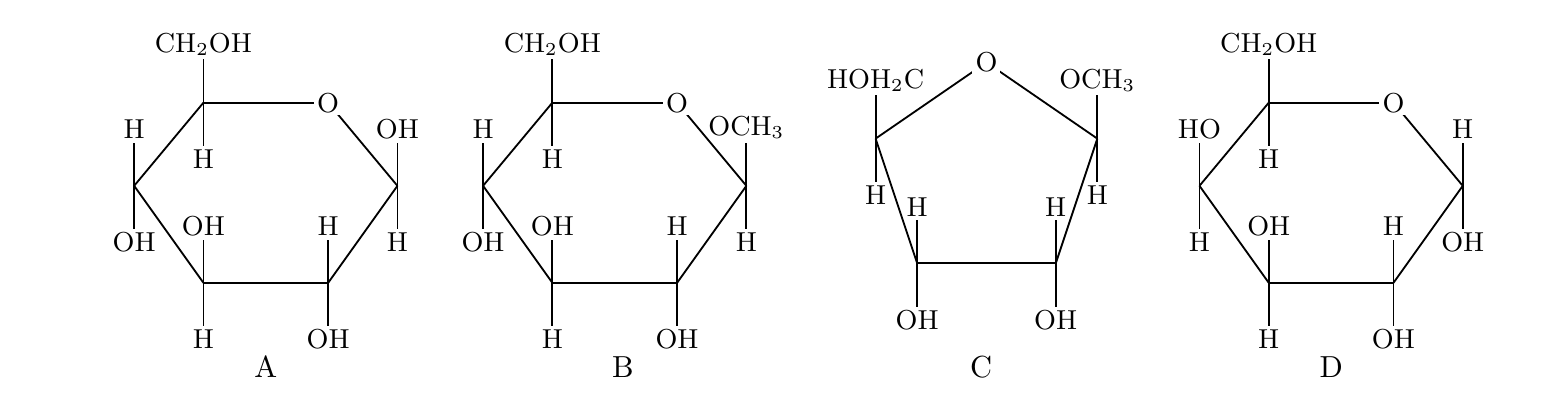
(See figure)
Theory · how these 9 PYQs are the same concept
A sugar reduces Tollens', Fehling's or Benedict's reagent only if its ring can open to a free aldehyde (or α-hydroxy ketone). That needs a hemiacetal: an anomeric carbon carrying OH and the ring O. In sucrose both anomeric carbons are tied in the C1–C2 glycosidic bond, so it is non-reducing; maltose and lactose keep one free hemiacetal and are reducing. Glycosides (acetals, OR on the anomeric C) do not react. Trap: calling every disaccharide reducing.
How NTA asks it
Rotated as picking the non-reducing disaccharide from structures, which cyclic structures react with Tollens', counting sugars negative to Benedict's, Fehling's test on sucrose, or functional groups in maltose.
- 2026 (Unique PYQ): Unique PYQ: four cyclic structures; acetals do not react with Tollens', hemiacetals do.
- 2026: Same hemiacetal test on four disaccharides; sucrose is the non-reducing one.
- 2026: Same idea reversed: pick the one structure that is a hemiacetal and reduces Tollens'.
- 2024: Same rule with Fehling's reagent: sucrose gives no red precipitate.
- 2023: Count form with Benedict's: sucrose and amylose lack a usable free carbonyl.
- 2022: Same check on drawn structures: which one has a free anomeric OH.
- 2021: Assertion-reason: sucrose is non-reducing because C1–C2 links both anomeric carbons.
- 2021: Non-reducing sugar that hydrolyses to two reducing monosaccharides is sucrose.
- 2020: Same structural idea in maltose: one acetal and one free hemiacetal group.
Tests for amino acids and peptides: ninhydrin, biuret, carbylamine, CAN, ester
Asked 7 times (2019, 2020, 2021, 2022, 2024) • covers 6 similar PYQs
Colour tests for carbohydrates: Molisch, Barfoed, Seliwanoff, Bial
Asked 7 times (2019, 2020, 2021, 2022, 2023) • covers 6 similar PYQs
Sucrose: α-glucose C1–β-fructose C2 link, hydrolysis gives laevorotatory invert sugar
Asked 6 times (2019, 2021, 2022, 2025, 2026) • covers 5 similar PYQs
Reactions of glucose: oxime, gluconic acid, saccharic acid, pentaacetate, n-hexane
Asked 6 times (2020, 2022, 2024, 2026) • covers 5 similar PYQs
Vitamins: chemical names and deficiency diseases
Asked 6 times (2020, 2021, 2023, 2025) • covers 5 similar PYQs
Number of possible peptide sequences (ordered arrangements)
Asked 5 times (2023, 2024, 2025, 2026) • covers 4 similar PYQs
Forces stabilising protein secondary and tertiary structure
Asked 5 times (2021, 2022, 2023, 2025) • covers 4 similar PYQs
Zwitterion and ionic form of amino acids at a given pH
Asked 5 times (2019, 2021, 2023, 2025) • covers 4 similar PYQs
Structures of nucleobases: A, G, C, T, U
Asked 5 times (2019, 2021, 2024, 2025) • covers 4 similar PYQs
Counting atoms or groups in a biomolecule from its structure
Asked 5 times (2020, 2022, 2023, 2024) • covers 4 similar PYQs
Counting chiral centres in sugars and amino acids
Asked 4 times (2019, 2020, 2025) • covers 3 similar PYQs
Fat-soluble vs water-soluble vitamins and storage in the body
Asked 4 times (2021, 2022, 2024, 2025) • covers 3 similar PYQs
Denaturation of proteins: only the primary structure survives
Asked 4 times (2022, 2024) • covers 3 similar PYQs
Fischer to Haworth: pyranose/furanose ring and α/β anomer
Asked 4 times (2021, 2022, 2023) • covers 3 similar PYQs
Deducing a sugar's structure from its reactions
Asked 4 times (2022, 2023) • covers 3 similar PYQs
Peptide bonds in a linear peptide: n residues give n − 1 bonds
Asked 4 times (2021, 2022, 2023) • covers 3 similar PYQs
Reading a peptide sequence from its structure (N- to C-terminus)
Asked 3 times (2019, 2023, 2026) • covers 2 similar PYQs
Sugar of nucleic acids: β-D-ribose (RNA) and β-D-2-deoxyribose (DNA)
Asked 3 times (2022, 2025, 2026) • covers 2 similar PYQs
D/L configuration of sugars from the lowest chiral carbon
Asked 3 times (2024, 2025) • covers 2 similar PYQs
Anomalies of glucose that show its cyclic hemiacetal structure
Asked 3 times (2020, 2024, 2025) • covers 2 similar PYQs
Essential amino acids (must come from the diet)
Asked 3 times (2020, 2024, 2025) • covers 2 similar PYQs
Proteins hydrolyse to α-amino acids
Asked 3 times (2023, 2024, 2025) • covers 2 similar PYQs
Forming and modifying peptides: N-terminus, acetylation, HNO2
Asked 3 times (2019, 2025) • covers 2 similar PYQs
DNA base pairing: A=T (2 H-bonds), G≡C (3 H-bonds)
Asked 3 times (2021, 2024, 2025) • covers 2 similar PYQs
Functions and structure of DNA and RNA; phosphodiester linkage
Asked 3 times (2019, 2024) • covers 2 similar PYQs
Acidic, neutral and basic amino acids from side chains
Asked 3 times (2019, 2023) • covers 2 similar PYQs
Enzymes in sugar chemistry: invertase, zymase, diastase, maltase
Asked 3 times (2021, 2022) • covers 2 similar PYQs
Structures of individual amino acids (side-chain features)
Asked 2 times (2021, 2026) • covers 1 similar PYQ
Enzymes: specific globular-protein biocatalysts that lower activation energy
Asked 2 times (2024, 2026) • covers 1 similar PYQ
Fructose: a ketohexose that still reduces Tollens' reagent
Asked 2 times (2021, 2025) • covers 1 similar PYQ
Epimers and anomers among monosaccharides
Asked 2 times (2019, 2024) • covers 1 similar PYQ
Sulphur-containing amino acids: cysteine and methionine
Asked 2 times (2023, 2024) • covers 1 similar PYQ
One-letter codes of amino acids
Asked 2 times (2023) • covers 1 similar PYQ
Fibrous vs globular proteins
Asked 2 times (2021) • covers 1 similar PYQ
Number of residues in a protein from osmotic pressure
Asked in 2022