JEE Main 2023 · JEE Main 08 Apr 2023 Shift-I
Replacing –N₂⁺ by Cl, Br, CN, I, F: Sandmeyer, Gattermann, Balz–Schiemann
Nitrocompounds, Alkyl Nitrites and Diazonium SaltsAsked 8 times (2020, 2021, 2023, 2024, 2025) • Solving this covers 7 similar PYQs
Match List I with List II:
Benzenediazonium chloride () is reacted with reagents in List I to form products in List II.
List I (Reagent)
A. Aniline ()
B. ,
C. Cu, HCl
D. CuCN/KCN
List II (Product)
I. Fluorobenzene ()
II. Benzonitrile ()
III. p-Aminoazobenzene ()
IV. Chlorobenzene ()
Choose the correct answer from the options given below:
Theory · how these 8 PYQs are the same concept
Diazonium group replacements: //CuCN (Sandmeyer), Cu powder/HX (Gattermann), KI (no catalyst) for iodide, then heat (Balz–Schiemann) for fluoride. The aryl halide can go on to Dow's process (phenol) or Fittig coupling (biphenyl), and ArCN to Stephen reduction (ArCHO). The trap is confusing Sandmeyer with Gattermann reagents.
How NTA asks it
Match reagents to products or named reactions, identify A/B/C in a short chain, or compute the molar mass of a later product.
- 2023 (Unique PYQ): Unique PYQ: match aniline, HBF₄, Cu/HCl, CuCN with benzenediazonium products.
- 2025: Same: Sandmeyer chlorobenzene then Fittig coupling; biphenyl molar mass 154.
- 2025: Same: KI replaces N₂⁺ by I; identify A, B, C.
- 2024: Same Sandmeyer step to chlorobenzene, then Dow's process gives phenol.
- 2024: Same: Cu₂Cl₂ replaces N₂⁺ by Cl (Sandmeyer).
- 2021: Same naming in a match: Cu₂Cl₂ is Sandmeyer, Cu/HCl is Gattermann.
- 2021: Same: N₂⁺ → CN, then Stephen reduction gives benzaldehyde.
- 2020: Same: Sandmeyer gives p-chlorotoluene; then benzylic chlorination.
JEE Main 2021 · JEE Main 26 Feb 2021 Shift-I
Hinsberg test: alkali solubility of the sulphonamide (1° soluble, 2° insoluble)
Aliphatic and Aromatic AminesAsked 7 times (2021, 2022, 2024, 2026) • Solving this covers 6 similar PYQs
An amine on reaction with benzenesulphonyl chloride produces a compound insoluble in alkaline solution. This amine can be prepared by ammonolysis of ethyl chloride. The correct structure of amine is :
Theory · how these 7 PYQs are the same concept
Benzenesulphonyl chloride (or tosyl chloride) reacts with N–H amines. A 1° amine gives , whose remaining N–H is acidic (pulled by ), so it dissolves in NaOH/KOH. A 2° amine gives with no N–H: an alkali-insoluble solid. A 3° amine does not react. The trap is thinking 2° sulphonamides dissolve, or that aryl amines behave differently.
How NTA asks it
Counting 1° or 2° amines in a list, identifying the amine from 'product insoluble in alkali', statement pairs on tosyl chloride, or choosing the reagent that separates 1°/2°/3° amines.
- 2021 (Unique PYQ): Unique PYQ: alkali-insoluble sulphonamide means 2°; ammonolysis of ethyl chloride puts in N-ethyl.
- 2026: Same rule; count 2° amines in a list (alkali-insoluble sulphonamides).
- 2024: Same test as statements: Ph₃N does not react; the 2° product is insoluble in alkali.
- 2024: Same rule reversed: count 1° amines, whose sulphonamides dissolve in NaOH.
- 2022: Same chemistry for p-toluenesulphonyl chloride; pick the wrong statement on solubility.
- 2021: Same: product soluble in dilute NaOH, so A is the 1° amine among options.
- 2021: Same idea as a separation method: an arenesulphonyl chloride separates 1°, 2° and 3°.
JEE Main 2022 · JEE Main 29 Jun 2022 Shift-I
Acetylation tames –NH₂: monobromination of acetanilide-type rings
Aliphatic and Aromatic AminesAsked 7 times (2020, 2021, 2022, 2023, 2025) • Solving this covers 6 similar PYQs
Consider the above reaction, the product A and product B respectively are
(See figure)
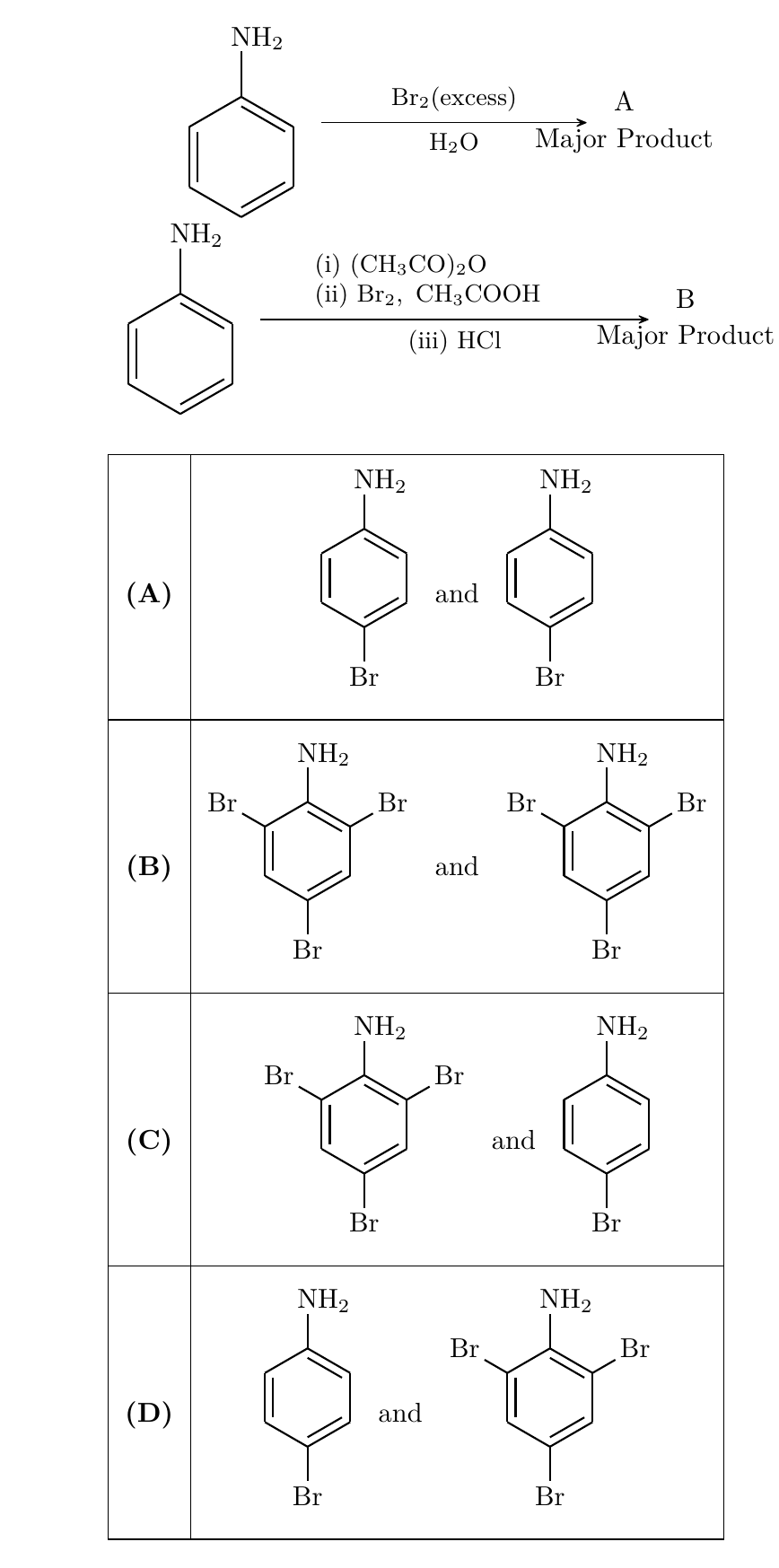
(See figure)
Theory · how these 7 PYQs are the same concept
Acetylation turns into , still o/p-directing but only moderately activating, so gives one substitution, mostly para (or ortho if para is blocked), instead of 2,4,6-tribromo. It dominates weaker directors like . Hydrolysis then restores . The trap is tribromination after protection.
How NTA asks it
Compare products with and without acetylation, identify A and B in nitration/bromination of protected anilines, or a para-blocked toluidine.
- 2022 (Unique PYQ): Unique PYQ: Br₂ water gives 2,4,6-tribromoaniline; acetanilide gives mono product.
- 2025: Same chain from nitrobenzene: reduce, acetylate, monobrominate, hydrolyse.
- 2023: Same protection after H₂/Pd reduction; acetanilide then substitutes para.
- 2023: Same: Br₂/AcOH gives mainly 4-bromoacetanilide.
- 2021: Same: N-acetylation, then the moderated group directs to para.
- 2020: Same: –NHCOCH₃ outranks CH₃; bromination ortho to it.
- 2020: Same: para is blocked in 4-methylacetanilide, so bromine goes ortho.
Deamination with H₃PO₂ or ethanol: using NH₂ as a removable director
Asked 7 times (2021, 2022, 2023, 2025) • covers 6 similar PYQs
Hofmann bromamide product: amine with one carbon fewer
Asked 7 times (2019, 2021, 2022, 2023) • covers 6 similar PYQs
1° aliphatic amine + HNO₂: N₂ gas and alcohol; structure deduction
Asked 6 times (2019, 2021, 2022, 2023, 2026) • covers 5 similar PYQs
Scope of Gabriel synthesis: only 1° amines on sp³ carbon
Asked 6 times (2019, 2020, 2021, 2023, 2026) • covers 5 similar PYQs
Azo coupling with aniline or N,N-dimethylaniline in acid: para C-coupling
Asked 6 times (2019, 2021, 2023) • covers 5 similar PYQs
Nitriles to amines: reduction to RCH₂NH₂ and one-carbon step-up
Asked 6 times (2019, 2020, 2021, 2022) • covers 5 similar PYQs
Multistep problems built on Hofmann degradation
Asked 5 times (2023, 2026) • covers 4 similar PYQs
Hydrolysis of amides, lactams and nitriles; RCN vs RNC
Asked 5 times (2021, 2023, 2025, 2026) • covers 4 similar PYQs
Basicity lowered by lone-pair delocalisation (aryl, acyl) and ring substituents
Asked 5 times (2019, 2021, 2025) • covers 4 similar PYQs
β-Naphthol test: orange-red dye confirms a 1° aromatic amine
Asked 5 times (2021, 2022, 2024, 2025) • covers 4 similar PYQs
Carbylamine test: only 1° amines (aliphatic or aryl) give isocyanides
Asked 5 times (2019, 2021, 2025) • covers 4 similar PYQs
Chemoselective N-acylation: –NH₂ acylated before –OH or amide N
Asked 5 times (2019, 2021, 2023) • covers 4 similar PYQs
Direct nitration of aniline gives much meta product (anilinium ion)
Asked 5 times (2021, 2022) • covers 4 similar PYQs
Mole and mass calculations in aniline reactions (yield, mass, % N)
Asked 4 times (2026) • covers 3 similar PYQs
Deduce an amine or salt from a set of test results
Asked 4 times (2020, 2022, 2023, 2026) • covers 3 similar PYQs
Sulphanilic acid dye with 1-naphthylamine: Griess–Ilosvay test
Asked 4 times (2023, 2024, 2025, 2026) • covers 3 similar PYQs
Reagent order with nitro/amino switching to get meta or para patterns
Asked 4 times (2021, 2022, 2023, 2026) • covers 3 similar PYQs
Reagents that give amines: nitro, amide and nitrile reductions
Asked 4 times (2021, 2023, 2025, 2026) • covers 3 similar PYQs
Basicity of alkylamines in water: 2° > 1° > 3° (methyl) and Et₂NH > Et₃N > EtNH₂
Asked 4 times (2019, 2023, 2025) • covers 3 similar PYQs
Grignard reagent + nitrile: imine salt hydrolysed to a ketone
Asked 4 times (2021, 2022, 2024) • covers 3 similar PYQs
Which amines react with Hinsberg's reagent: N–H needed
Asked 3 times (2024, 2025) • covers 2 similar PYQs
Basicity of special N structures: cage amines, pyridine, twisted amides
Asked 3 times (2020, 2022, 2025) • covers 2 similar PYQs
Coupling with phenol or 1-naphthol in alkali: para position of the phenoxide
Asked 3 times (2019, 2024, 2025) • covers 2 similar PYQs
Gabriel synthesis steps: phthalimide anion, N-alkylation, release
Asked 3 times (2019, 2021, 2024) • covers 2 similar PYQs
Ammonolysis of halides: amine salts, role of NaOH, intramolecular alkylation
Asked 3 times (2021, 2024) • covers 2 similar PYQs
General properties of amines: H-bonding, colour on storage, salts as acids
Asked 3 times (2021, 2023) • covers 2 similar PYQs
Bromination of 4-nitrotoluene ortho to CH₃, then reduce and diazotise
Asked 3 times (2023) • covers 2 similar PYQs
Identity of named amine reagents and reactions (Hinsberg = C₆H₅SO₂Cl)
Asked 3 times (2019, 2022) • covers 2 similar PYQs
Aniline fails in Friedel–Crafts: Lewis acid–base salt with AlCl₃
Asked 3 times (2021, 2022) • covers 2 similar PYQs
Hofmann bromamide mechanism: N-bromoamide, isocyanate, carbonate
Asked 3 times (2021, 2022) • covers 2 similar PYQs
Methyl orange: diazotised sulphanilic acid + N,N-dimethylaniline
Asked 3 times (2020, 2021) • covers 2 similar PYQs
Stability of arenediazonium salts: donors stabilise, acceptors destabilise
Asked 2 times (2021, 2026) • covers 1 similar PYQ
Regiocontrol tricks on protected anilines: blocking groups, which ring reacts
Asked 2 times (2019, 2025) • covers 1 similar PYQ
EAS on substituted benzenes in nitration/bromination sequences
Asked 2 times (2022, 2024) • covers 1 similar PYQ
C-Nitrosation by NO⁺ of strongly activated rings
Asked 2 times (2023) • covers 1 similar PYQ
Isocyanide vs nitrile from halides: AgCN (N-attack) vs KCN (C-attack)
Asked 2 times (2019, 2023) • covers 1 similar PYQ
Diazonium salt + water on warming gives phenol
Asked 2 times (2021, 2022) • covers 1 similar PYQ
Identify an aryl amine from tribromination and azo-dye formation
Asked 2 times (2020) • covers 1 similar PYQ
3-Bromoaniline route: Sandmeyer to 1,3-dibromobenzene, then nitration
Asked 2 times (2020) • covers 1 similar PYQ
Sulphonation of aniline to sulphanilic acid; Lassaigne test for N and S
Asked in 2024
Markovnikov addition of HI to a substituted cycloalkene
Asked in 2024
o-Phenylenediamine + HNO₂: intramolecular capture gives benzotriazole
Asked in 2023
Hofmann elimination of quaternary ammonium: less substituted alkene
Asked in 2022
Oxidation of aniline with acidified dichromate to p-benzoquinone
Asked in 2021