Carboxylic Acids and Their Derivatives
57 PYQs → 19 unique concepts, 38 similar PYQs. The first 3 are free.
JEE Main 2025 · JEE Main 28 Jan 2025 Shift-II
Hot alkaline KMnO4 oxidises any side chain with a benzylic H to –COOH
Carboxylic AcidsAsked 6 times (2019, 2021, 2024, 2025) • Solving this covers 5 similar PYQs
The total number of compounds from below when treated with hot giving benzoic acid is :
(See figure)
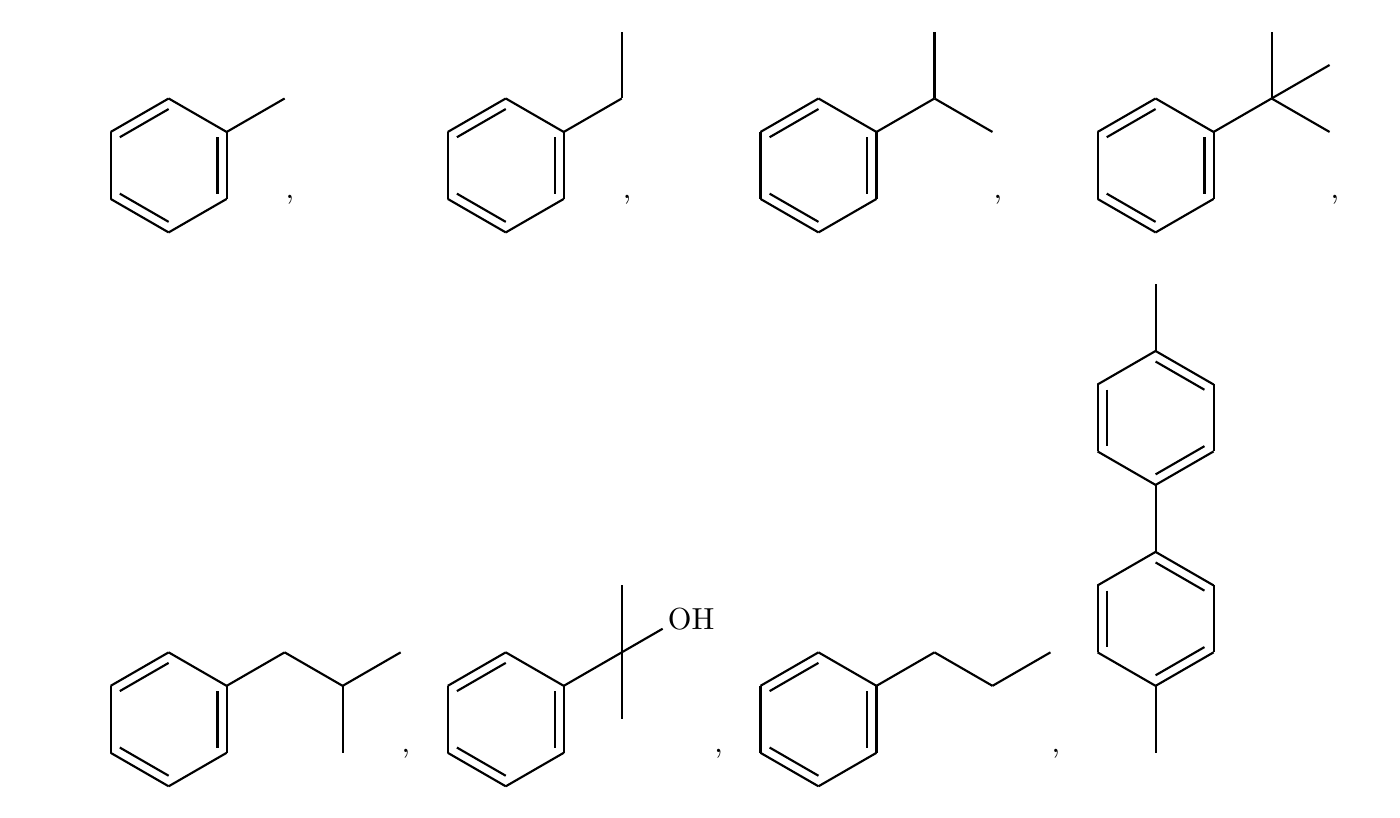
(See figure)
Theory · how these 6 PYQs are the same concept
Hot alkaline KMnO4 followed by acid cuts every carbon side chain on a benzene ring down to –COOH, whatever its length, provided the benzylic carbon carries at least one H (or is already oxidised, like –COCH3). tert-Butylbenzene has no benzylic H and is not oxidised. Two side chains give a dicarboxylic acid. The –COOH formed is deactivating and meta-directing, so later nitration or bromination goes meta. Trap: stopping at a ketone or aldehyde, or sending the next group ortho/para.
How NTA asks it
Asked as the product of one oxidation, the reagent for ArCH3 → ArCOOH, a count of compounds that give benzoic acid, or as a sequence oxidation → nitration/bromination with pi bonds of the final product counted.
- 2025 (Unique PYQ): Unique PYQ: count the compounds that give benzoic acid with hot KMnO4 (benzylic H needed).
- 2024: Oxidation of ethylbenzene, then nitration meta to COOH; asks pi bonds in m-nitrobenzoic acid.
- 2024: Same oxidise-then-substitute chain with Br2/FeBr3; pi bonds in m-bromobenzoic acid counted.
- 2021: Reverse form: the reagent that turns an aryl CH3 into COOH has to be picked.
- 2019: Same oxidation on a single alkylbenzene; the product is simply benzoic acid.
- 2019: Same rule with two side chains (CH3 and COCH3): both become COOH, terephthalic acid.
JEE Main 2023 · JEE Main 10 Apr 2023 Shift-II
LiAlH4 reduction of acids, esters and amides; isolated C=C untouched
Acid Derivatives (Acid Chlorides, Esters, Amides, Anhydrides)Asked 5 times (2019, 2021, 2023) • Solving this covers 4 similar PYQs
In the reaction given below
The product 'X' is :
(See figure)
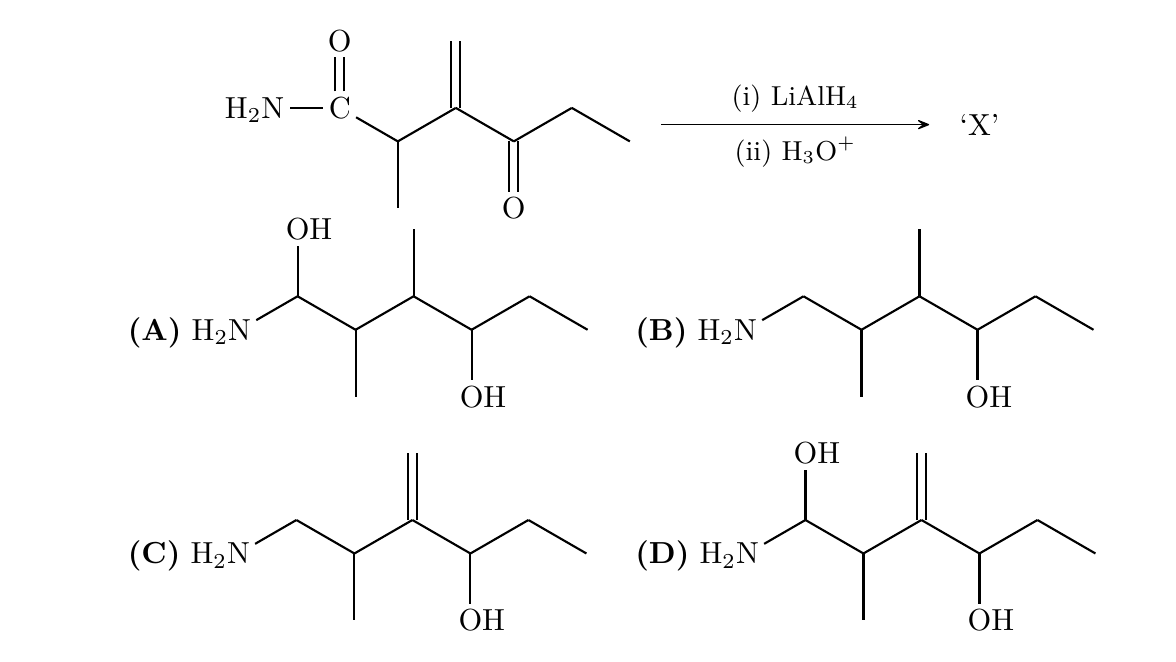
The product 'X' is :
(See figure)
Theory · how these 5 PYQs are the same concept
LiAlH4 is a strong hydride donor. Acid → primary alcohol; ester RCOOR' → RCH2OH + R'OH (the acyl part and the alkoxy part end up as two alcohols); amide → amine (C=O becomes CH2, nitrogen kept); ketone → secondary alcohol; nitro → amine. It does not add to an isolated C=C. So in any molecule reduce every polar multiple bond and leave the alkene. Trap: reducing an amide to an alcohol, or losing the ester's alkoxy carbon count.
How NTA asks it
Asked as the product from a polyfunctional molecule, from a simple unsaturated ester, after first making an amide from an acid, or backwards: which C6 ester gives a C4 acid after reduction and oxidation.
- 2023 (Unique PYQ): Unique PYQ: keto-amide with a C=C; LiAlH4 gives amino alcohol with the double bond intact.
- 2023: Same amide-to-amine reduction after SOCl2 and RNH2 convert the acid into an amide.
- 2021: Reverse form: C6 ester split by LiAlH4, alcohol oxidised to a C4 acid; find the ester.
- 2019: Simplest case: unsaturated ester gives the allylic alcohol but-2-en-1-ol.
- 2019: Same reagent in excess on acid + ketone + nitro compound; all reduced except the C=C.
JEE Main 2025 · JEE Main 28 Jan 2025 Shift-I
NaHCO3 / NaOH solubility: separating acids, phenols, esters and neutral compounds
Carboxylic AcidsAsked 4 times (2023, 2025) • Solving this covers 3 similar PYQs
The compounds that produce with aqueous solution are:
A., B., C., D., E. (structures in the figure)
Choose the correct answer from the options given below:
(See figure)
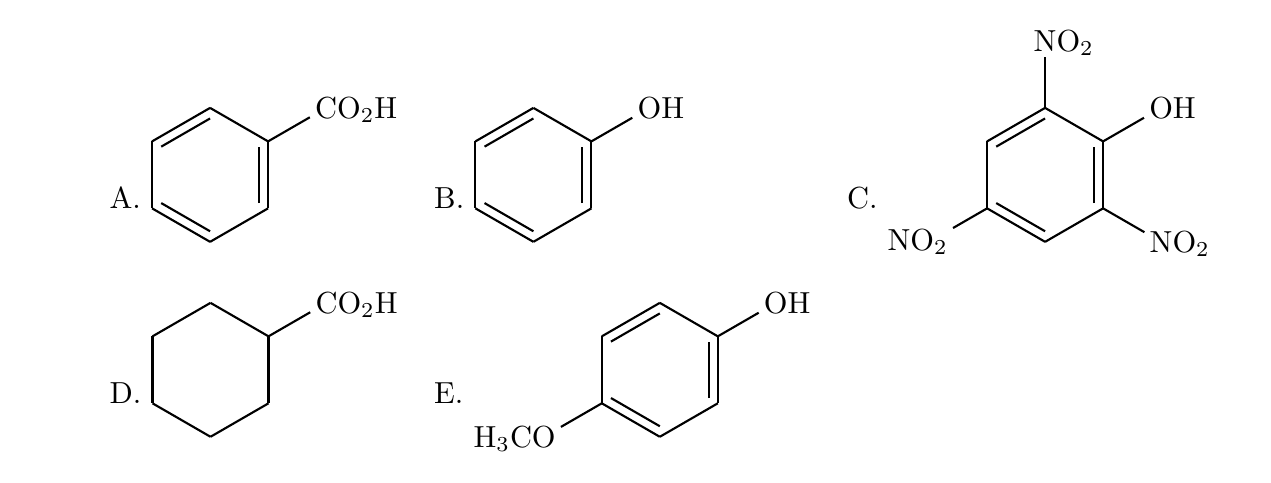
A., B., C., D., E. (structures in the figure)
Choose the correct answer from the options given below:
(See figure)
Theory · how these 4 PYQs are the same concept
NaHCO3 reacts only with acids stronger than carbonic acid (pKa about 6.4): carboxylic acids, sulphonic acids, picric acid, and anilinium salts; CO2 is evolved. Ordinary phenols, even mono-nitrophenols, dissolve in NaOH but give no CO2 with NaHCO3. Esters dissolve in neither cold reagent but are hydrolysed by hot NaOH. Amines, ethers and aryl halides stay in the organic layer with base. Trap: forgetting picric acid behaves like a carboxylic acid.
How NTA asks it
Asked as which compounds do or do not give CO2 with NaHCO3, as a count of compounds soluble only in hot NaOH, or as a separating-funnel problem naming what stays in the organic layer.
- 2025 (Unique PYQ): Unique PYQ: pick the structures that liberate CO2 from aqueous NaHCO3 (acids and picric acid).
- 2025: Same acid-base logic as an extraction: what remains in ethyl acetate after shaking with NaOH.
- 2025: Same test asked negatively: least likely to give effervescence (3-nitrophenol).
- 2023: Same solubility logic extended: count compounds insoluble in cold base but dissolving in hot NaOH (esters).
Reactivity order of acyl derivatives: RCOCl > anhydride > ester > amide
Asked 4 times (2019, 2021, 2025) • covers 3 similar PYQs
Named conversions of acids and derivatives: matching reaction with reagent
Asked 4 times (2021, 2022, 2024) • covers 3 similar PYQs
Nucleophilic acyl substitution: esterification and acylation of –OH / –NH2
Asked 4 times (2019, 2021, 2022, 2023) • covers 3 similar PYQs
Intramolecular ring closure to lactone, lactam or cyclic acetal-ester
Asked 4 times (2019, 2023) • covers 3 similar PYQs
Acid strength order of carboxylic acids and other acidic hydrogens (pKa)
Asked 3 times (2019, 2025, 2026) • covers 2 similar PYQs
Which route gives a carboxylic acid: comparing preparation methods
Asked 3 times (2021, 2023, 2025) • covers 2 similar PYQs
Grignard reagent + CO2, then H3O+: carboxylic acid with one extra carbon
Asked 3 times (2020, 2021) • covers 2 similar PYQs
Friedel–Crafts acylation with acid chlorides and cyclic anhydrides
Asked 2 times (2024) • covers 1 similar PYQ
Halolactonisation: unsaturated acid + X2/NaHCO3 gives a halo-lactone
Asked 2 times (2022, 2023) • covers 1 similar PYQ
Decarboxylation with soda lime and deducing the acid from its products
Asked 2 times (2020, 2022) • covers 1 similar PYQ
Hydrogen bonding and physical properties of carboxylic acids
Asked 2 times (2020, 2022) • covers 1 similar PYQ
Acid + NH3, heat → amide / imide, then Hofmann or Gabriel to amine
Asked 2 times (2019, 2022) • covers 1 similar PYQ
DIBAL-H at low temperature: ester, lactone or nitrile to aldehyde
Asked 2 times (2021, 2022) • covers 1 similar PYQ
Cyclic anhydride formation from dicarboxylic acids: ring size and geometry
Asked 2 times (2019, 2021) • covers 1 similar PYQ
Diborane (B2H6) reduces –COOH selectively in a polyfunctional molecule
Asked 2 times (2020) • covers 1 similar PYQ
Recognising –COOH in commonly named 'acids'
Asked in 2021