Aldehydes and Ketones
142 PYQs → 43 unique concepts, 99 similar PYQs. The first 3 are free.
JEE Main 2025 · JEE Main 03 Apr 2025 Shift-I
Iodoform test: needs CH3CO- or CH3CH(OH)- (count / distinguish)
Nucleophilic Addition and Named ReactionsAsked 6 times (2023, 2025, 2026) • Solving this covers 5 similar PYQs
Number of molecules from below which cannot give iodoform reaction is :
Ethanol, Isopropyl alcohol, Bromoacetone, 2-Butanol, 2-Butanone, Butanal, 2-Pentanone, 3-Pentanone, Pentanal and 3-Pentanol
Ethanol, Isopropyl alcohol, Bromoacetone, 2-Butanol, 2-Butanone, Butanal, 2-Pentanone, 3-Pentanone, Pentanal and 3-Pentanol
Theory · how these 6 PYQs are the same concept
I2/NaOH (NaOI, or KI + NaOCl giving KOI, an oxidant) gives yellow CHI3 with compounds having CH3CO- bonded to C or H, or CH3CH(OH)- that can oxidise to it: ethanol, acetaldehyde, isopropyl alcohol, butan-2-ol, methyl ketones, even enones like CH3CH=CHCOCH3. Methanol, acetic acid, 3-pentanone, butanal do not respond. Trap: CH3COOH and CH3COOR fail because the carbonyl is part of an acid/ester.
How NTA asks it
Asked as how many listed compounds give or do not give iodoform, which pairs it can distinguish, which compounds give the yellow solid, or statements about the haloform reagents.
- 2025 (Unique PYQ): Unique PYQ: count compounds among ten that cannot give iodoform.
- 2026: Which pairs the iodoform test can distinguish; same CH3CO- criterion.
- 2026: Statements on the reaction: KOI formation, its oxidising nature, an enone that responds.
- 2025: Which listed compounds give the yellow solid with NaOI/NaOH.
- 2023: Same structural test across six alcohols and ketones; count positives.
- 2023: Same count over drawn aryl ketones and alcohols.
JEE Main 2024 · JEE Main 30 Jan 2024 Shift-II
Cannizzaro reaction: aldehydes without α-H disproportionate in conc. base
Nucleophilic Addition and Named ReactionsAsked 6 times (2019, 2021, 2022, 2024, 2025) • Solving this covers 5 similar PYQs
m-chlorobenzaldehyde on treatment with 50% KOH solution yields
(See figure)
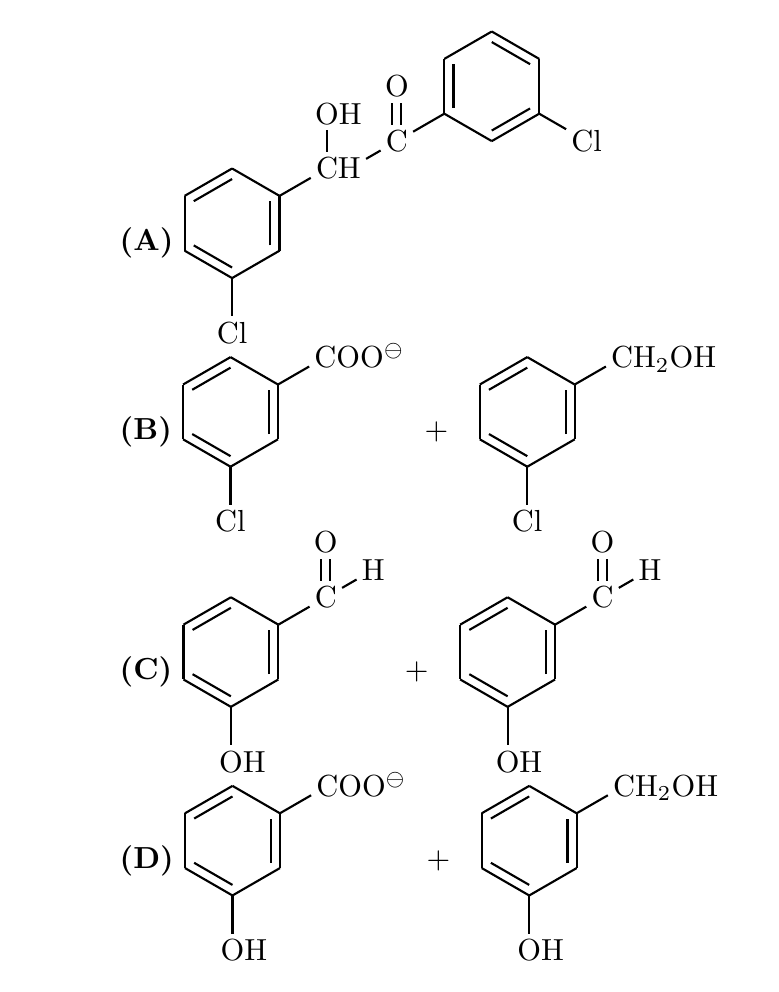
(See figure)
Theory · how these 6 PYQs are the same concept
Aldehydes with no α-H (HCHO, ArCHO, phenylglyoxal) in concentrated KOH/NaOH disproportionate: OH- adds to one molecule, which transfers a hydride directly to a second molecule, giving the carboxylate and the alcohol. In crossed Cannizzaro HCHO is oxidised to formate and the other aldehyde reduced. The transferred H comes from carbon, not from D2O, so ArCH2OH keeps C-H, and only OD exchanges. Trap: putting D on carbon.
How NTA asks it
Asked as products of m-chlorobenzaldehyde with 50% KOH, structure of A in NaOD/D2O, which product is not formed, crossed Cannizzaro with HCHO, or intramolecular Cannizzaro of PhCOCHO.
- 2024 (Unique PYQ): Unique PYQ: m-chlorobenzaldehyde with 50% KOH gives the acid salt and the alcohol.
- 2025: Intramolecular version: PhCOCHO gives mandelate (PhCH(OH)COO-).
- 2022: Same reaction in NaOD/D2O: the transferred hydride is H, not D.
- 2021: Cannizzaro of 4-(hydroxymethyl)benzaldehyde; which product does not form.
- 2021: Crossed Cannizzaro with HCHO gives ArCH2OH, then NaH/alkyl halide step.
- 2019: Crossed Cannizzaro: HCHO is oxidised to formate, the other aldehyde reduced.
JEE Main 2024 · JEE Main 29 Jan 2024 Shift-I
Tollens and Fehling tests: which compounds reduce them
Nucleophilic Addition and Named ReactionsAsked 6 times (2021, 2022, 2024, 2025) • Solving this covers 5 similar PYQs
From the compounds given below, number of compounds which give positive Fehling's test is ______
Benzaldehyde, Acetaldehyde, Acetone, Acetophenone, Methanal, 4-nitrobenzaldehyde, cyclohexane carbaldehyde.
Benzaldehyde, Acetaldehyde, Acetone, Acetophenone, Methanal, 4-nitrobenzaldehyde, cyclohexane carbaldehyde.
Theory · how these 6 PYQs are the same concept
Tollens' reagent ([Ag(NH3)2]+) is reduced to a silver mirror by all aldehydes, formic acid, α-hydroxy ketones and hemiacetals/enols that open to aldehydes. Fehling's solution (Cu2+ tartrate) is reduced only by aliphatic aldehydes (including PhCH2CHO and α-hydroxy ketones like fructose), not by aromatic aldehydes like benzaldehyde. Ketones fail both; Tollens oxidises only CHO in a keto-aldehyde. Trap: counting benzaldehyde as Fehling positive.
How NTA asks it
Asked as which compounds give a silver mirror, how many give Fehling's test, which drawn compounds do not reduce Tollens, products of Tollens on a keto-aldehyde, or tests common to acetaldehyde and acetone.
- 2024 (Unique PYQ): Unique PYQ: count compounds giving Fehling's test among seven aldehydes and ketones.
- 2025: Compares reactions (iodoform, aldol, Tollens, Cannizzaro, Clemmensen) common to CH3CHO and acetone.
- 2025: Same Fehling selectivity: aliphatic aldehydes and a ketose, not PhCHO.
- 2024: Tollens version: formic acid, formaldehyde, benzaldehyde give a mirror; acetone does not.
- 2022: Tollens oxidises only the CHO of a keto-aldehyde; ketone unaffected.
- 2021: Which drawn compounds do not give a silver mirror (enol and hemiacetal still do).
DIBAL-H partial reduction: nitrile or ester to aldehyde
Asked 6 times (2019, 2021, 2022, 2024) • covers 5 similar PYQs
Cyanohydrin formation and conversion (hydrolysis, ester, reduction, dehydration)
Asked 6 times (2021, 2022, 2023) • covers 5 similar PYQs
Name reactions for aldehyde synthesis: Rosenmund, Stephen, Etard, Gattermann-Koch
Asked 5 times (2020, 2022, 2023, 2025, 2026) • covers 4 similar PYQs
Crossed aldol: how many products; one partner without α-H
Asked 5 times (2021, 2024, 2026) • covers 4 similar PYQs
Acetal/ketal formation: rate, protection and stability to base
Asked 5 times (2019, 2021, 2023, 2026) • covers 4 similar PYQs
Structure deduction of carbonyl compounds from combined tests
Asked 5 times (2019, 2023, 2025, 2026) • covers 4 similar PYQs
Intramolecular aldol: enolate closes a 5- or 6-membered ring, then dehydrates
Asked 5 times (2019, 2021, 2023, 2025) • covers 4 similar PYQs
Friedel-Crafts acylation as a route to aryl ketones
Asked 5 times (2019, 2021, 2022, 2024) • covers 4 similar PYQs
Grignard addition to aldehydes/ketones: alcohol class and back-identification
Asked 5 times (2020, 2022) • covers 4 similar PYQs
Reactivity toward nucleophilic addition: HCHO > RCHO > ketones; EWG increase
Asked 4 times (2020, 2024, 2025) • covers 3 similar PYQs
Choosing Clemmensen vs Wolff-Kishner (C=O to CH2) by acid/base sensitivity
Asked 4 times (2021, 2023, 2024) • covers 3 similar PYQs
Self-aldol of one carbonyl compound: addition vs condensation
Asked 4 times (2021, 2022, 2023) • covers 3 similar PYQs
NaBH4 selectivity: reduces C=O (and C=N), not esters or isolated C=C
Asked 4 times (2019) • covers 3 similar PYQs
Matching reagents with carbonyl reductions, tests and named reactions
Asked 3 times (2023, 2024, 2026) • covers 2 similar PYQs
Toluene to benzaldehyde: Etard (CrO2Cl2) or CrO3/acetic anhydride
Asked 3 times (2022, 2025) • covers 2 similar PYQs
Alkyne hydration (HgSO4/H2SO4): Markovnikov, ketones except from ethyne
Asked 3 times (2020, 2021, 2025) • covers 2 similar PYQs
Ozonolysis products and back-working the alkene from carbonyl tests
Asked 3 times (2020, 2025) • covers 2 similar PYQs
Clemmensen reduction products: both C=O to CH2, esters untouched
Asked 3 times (2021, 2024, 2025) • covers 2 similar PYQs
Crossed aldol with HCHO then cyanohydrin or crossed Cannizzaro
Asked 3 times (2022, 2023, 2025) • covers 2 similar PYQs
Hydration and bisulfite addition: equilibria, mechanism, hydrate stability
Asked 3 times (2021, 2023, 2025) • covers 2 similar PYQs
Ozonolysis of a cyclic alkene then intramolecular aldol
Asked 3 times (2020, 2025) • covers 2 similar PYQs
Hydrolysis of gem-dihalides gives aldehydes or ketones
Asked 3 times (2019, 2021, 2024) • covers 2 similar PYQs
Rosenmund route: acid to acid chloride (SOCl2) to aldehyde (H2, Pd-BaSO4)
Asked 3 times (2019, 2021, 2024) • covers 2 similar PYQs
Condensation with ammonia derivatives: semicarbazone, 2,4-DNP hydrazone
Asked 3 times (2021, 2024) • covers 2 similar PYQs
Acidic O-H/COOH consumes Grignard reagent before carbonyl addition
Asked 3 times (2019, 2023, 2024) • covers 2 similar PYQs
Claisen-Schmidt: 2 PhCHO + acetone gives dibenzalacetone
Asked 2 times (2024, 2025) • covers 1 similar PYQ
Gattermann-Koch formylation: benzene + CO/HCl, AlCl3/CuCl gives benzaldehyde
Asked 2 times (2024) • covers 1 similar PYQ
Tollens reaction stoichiometry: RCHO + 2[Ag(NH3)2]+ gives 2Ag
Asked 2 times (2021, 2023) • covers 1 similar PYQ
Stereochemistry of HCN addition to a planar C=O
Asked 2 times (2022, 2023) • covers 1 similar PYQ
Enolate alkylation/acylation at the α-carbon (SN2 alkylation, Claisen)
Asked 2 times (2022) • covers 1 similar PYQ
Enamine formation from ketones and secondary amines
Asked 2 times (2022) • covers 1 similar PYQ
Nitrile + Grignard then hydrolysis gives a ketone
Asked 2 times (2020, 2021) • covers 1 similar PYQ
Oxidising alcohols to carbonyls: PCC/CrO3 vs Jones over-oxidation
Asked 2 times (2021) • covers 1 similar PYQ
Catalytic/industrial routes: hydroformylation and alkane oxidation
Asked 2 times (2021) • covers 1 similar PYQ
Haloform reaction as a synthesis: methyl ketone to carboxylic acid
Asked 2 times (2021) • covers 1 similar PYQ
Strecker synthesis: aldehyde + NH3 + HCN gives α-amino acid
Asked in 2023
Vigorous oxidation of cyclic ketones: ring cleavage to keto acids
Asked in 2023
Conjugate (1,4) addition of organocuprates to enones
Asked in 2023
Conjugated diketone: C=O groups linked through alternating π bonds
Asked in 2022
Aromatic stabilisation of protonated cyclopropenone
Asked in 2020