Alcohols Phenols and Ethers
140 PYQs → 45 unique concepts, 95 similar PYQs. The first 3 are free.
JEE Main 2024 · JEE Main 29 Jan 2024 Shift-II
Reimer–Tiemann reaction: phenol + CHCl3/NaOH gives salicylaldehyde via :CCl2
PhenolsAsked 7 times (2019, 2021, 2022, 2024, 2026) • Solving this covers 6 similar PYQs
Phenol treated with chloroform in presence of sodium hydroxide, which further hydrolysed in presence of an acid results
Theory · how these 7 PYQs are the same concept
Chloroform and alkali generate dichlorocarbene, . The phenoxide ion attacks it mainly at the ortho position to give sodium 2-(dichloromethyl)phenoxide; alkali hydrolyses to CHO and acid gives salicylaldehyde (2-hydroxybenzaldehyde). The ortho isomer is the major product and is steam-volatile because of intramolecular H-bonding. With the product is salicylic acid. Trap: choosing the para aldehyde, or the trichloromethyl intermediate.
How NTA asks it
Rotated as product, reagent, intermediate structure, statement pairs on ortho vs para, or as one step in a deduction chain or a sequence with a further reaction.
- 2024 (Unique PYQ): Direct product question: phenol, $\mathrm{CHCl_3}$/NaOH, then acid gives 2-hydroxybenzaldehyde.
- 2026: Statement form: says para is major (false); second statement on separating the isomers is true.
- 2024: Asks the intermediate: sodium 2-(dichloromethyl)phenoxide.
- 2024: Unknown swapped: asks which reagent pair converts phenol to salicylaldehyde.
- 2022: Same intermediate question with trichloromethyl and un-ionised decoys in the options.
- 2021: Deduction chain: $\mathrm{C_6H_6O}$ with $\mathrm{FeCl_3}$ colour, then RT; B also from PCC on the hydroxybenzyl alcohol.
- 2019: RT on 4-chlorophenol followed by crossed Cannizzaro with HCHO to the benzyl alcohol.
JEE Main 2021 · JEE Main 26 Aug 2021 Shift-I
Bromination of phenol: Br2 in CS2/CHCl3 (mono) vs bromine water (2,4,6-tribromo)
PhenolsAsked 7 times (2021, 2022, 2023, 2024, 2025) • Solving this covers 6 similar PYQs
The correct options for the products A and B of the following reactions are :
(See figure)
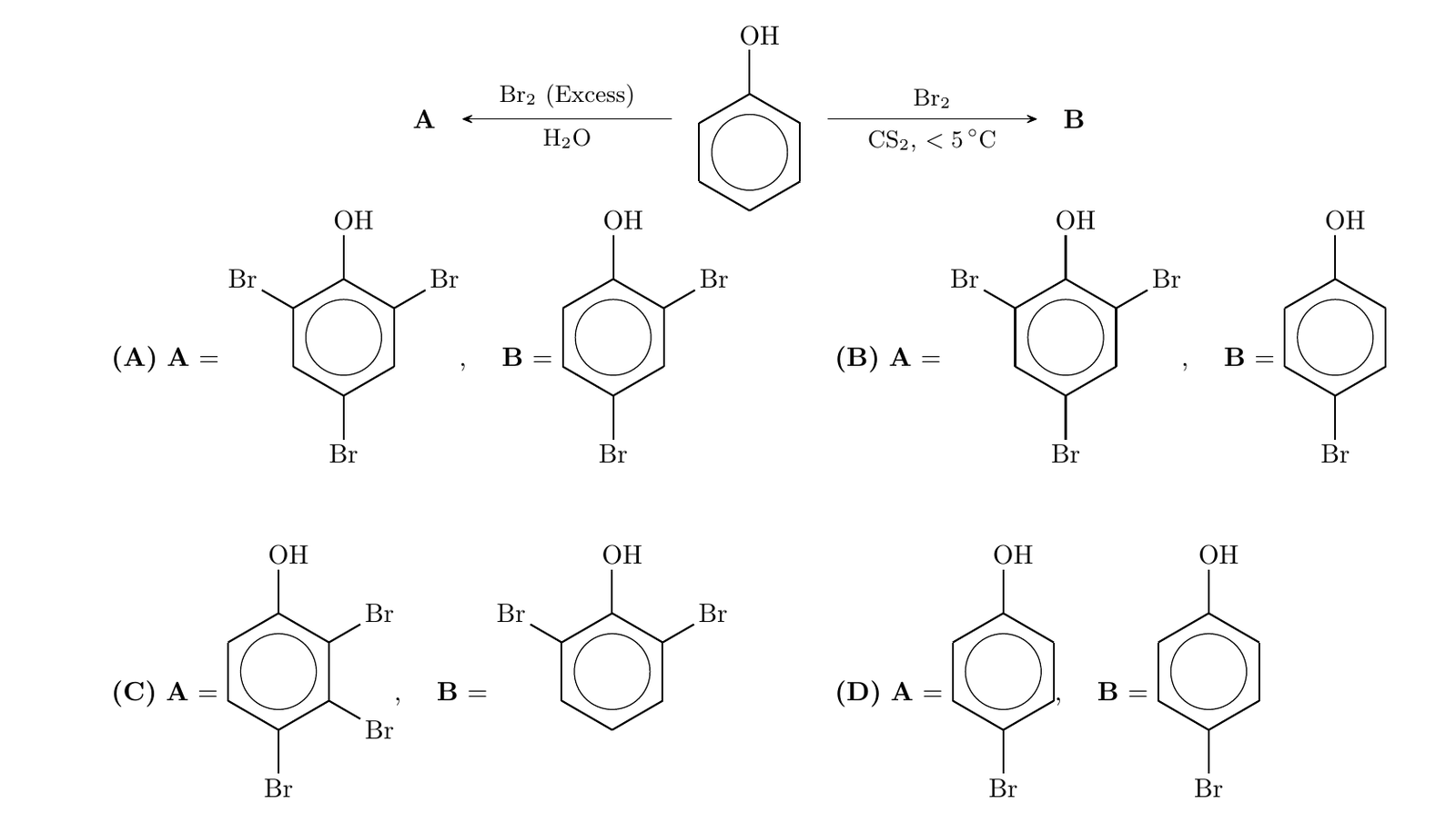
(See figure)
Theory · how these 7 PYQs are the same concept
The OH group activates the ring so strongly that no Lewis acid is needed. In a solvent of low polarity (, ) at low temperature, phenol stays un-ionised and gives monobromophenols, mainly para. In water, phenol partly ionises to the far more reactive phenoxide and is polarised, so all ortho and para positions react: white 2,4,6-tribromophenol, using 3 mol . Trap: asking for , or giving the ortho isomer as major.
How NTA asks it
Rotated as the product in each solvent, the reason for the difference, a statement pair on the Lewis acid, 'which conditions give monobromination', and a mass calculation.
- 2021 (Unique PYQ): Asks both products: bromine water gives 2,4,6-tribromophenol, $\mathrm{Br_2/CS_2}$ gives 4-bromophenol.
- 2025: Numerical: mass of $\mathrm{Br_2}$ for 2 g phenol using the 1 : 3 mole ratio.
- 2024: Statement form: Lewis acid is not required for phenol (I false), though it does polarise $\mathrm{Br_2}$.
- 2023: Phenol identified from $\mathrm{C_6H_6O}$ and sooty flame; low-polarity bromination gives 4-bromophenol.
- 2022: Asks only the reason for the difference: polarity of the solvent.
- 2021: Pick every condition that gives the monobromo product; bromine water is excluded.
- 2021: Two reactions of phenol: $\mathrm{Br_2/CS_2}$ (para-bromo) and Reimer–Tiemann (ortho-aldehyde).
JEE Main 2021 · JEE Main 18 Mar 2021 Shift-II
HI/HBr cleavage of alkyl aryl ethers: phenol + alkyl halide, Ar–O never breaks
EthersAsked 7 times (2019, 2020, 2021, 2022, 2025) • Solving this covers 6 similar PYQs
Main Products formed during a reaction of 1-methoxy naphthalene with hydroiodic acid are:
(See figure)
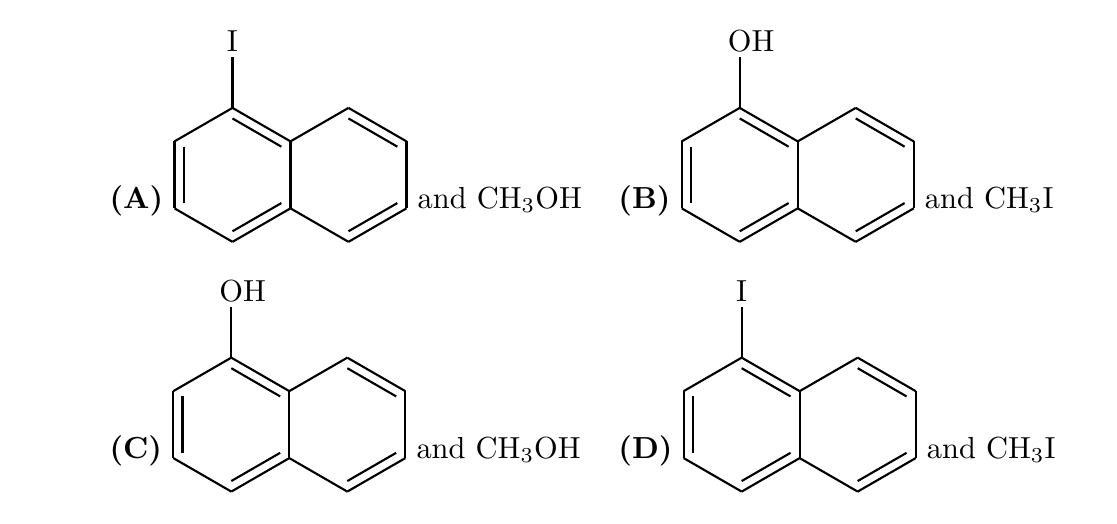
(See figure)
Theory · how these 7 PYQs are the same concept
HX protonates the ether oxygen and the halide ion attacks the alkyl carbon, so gives ArOH + RX. The aryl–oxygen bond is never cleaved (partial double-bond character, sp carbon), so no aryl halide forms even with excess acid. Excess HX still reacts with other groups in the molecule: it adds to a side-chain C=C through the benzylic cation and replaces alcoholic OH. Trap: writing iodobenzene, or anti-Markovnikov addition on the side chain.
How NTA asks it
Rotated from plain anisole-type ethers (products asked) to substrates with a vinyl, alkenyl or second ether group where excess HBr/HI does two jobs; sometimes a follow-up step is added.
- 2021 (Unique PYQ): 1-Methoxynaphthalene + HI: products are 1-naphthol and $\mathrm{CH_3I}$.
- 2025: Reverse choice: which of four ethers/acetals gives a phenol with HBr (anisole).
- 2022: Isopropyl phenyl ether + HI gives phenol; Zn dust then reduces it to benzene.
- 2020: Cyclic aryl alkyl ether opened by HBr to a bromoalkyl phenol; Na/ether then closes a ring (Wurtz).
- 2019: Two ether groups: aryl methyl ether gives ArOH; the other cleaves away from the CN-bearing carbon.
- 2019: Methoxy-styrene + excess HBr: phenol forms and HBr adds Markovnikov to the vinyl group.
- 2019: p-Propenylanisole + excess HBr: phenol plus Br on the benzylic carbon of the side chain.
Williamson synthesis: phenoxide/alkoxide + methyl or 1° halide (SN2)
Asked 6 times (2019, 2021, 2023, 2025) • covers 5 similar PYQs
Building an alcohol from a carbonyl compound + Grignard reagent
Asked 5 times (2019, 2021, 2023, 2025, 2026) • covers 4 similar PYQs
Reagent–product map of phenol (Kolbe, Reimer–Tiemann, Zn dust, dichromate, HNO3)
Asked 5 times (2022, 2024, 2026) • covers 4 similar PYQs
Reagent chains across oxidation levels (LiAlH4, PCC, Jones, KMnO4, soda lime)
Asked 5 times (2022, 2024, 2025) • covers 4 similar PYQs
Industrial phenol: cumene hydroperoxide route and Dow's process
Asked 5 times (2019, 2022, 2023, 2025) • covers 4 similar PYQs
Dehydration of a 3° alcohol to the Saytzeff alkene (no rearrangement)
Asked 5 times (2020, 2022, 2024) • covers 4 similar PYQs
Carbocation 1,2-hydride shift before elimination or nucleophile capture
Asked 5 times (2020, 2021, 2023, 2024) • covers 4 similar PYQs
Identifying a phenol by solubility and tests: NaOH yes, NaHCO3 no, FeCl3 colour
Asked 4 times (2019, 2022, 2025, 2026) • covers 3 similar PYQs
HX cleavage of dialkyl ethers and epoxides: SN2 at the less hindered carbon, SN1 if 3°
Asked 4 times (2020, 2024, 2026) • covers 3 similar PYQs
Phthalein dye test: phenol + phthalic anhydride needs a free para position
Asked 4 times (2021, 2023, 2024) • covers 3 similar PYQs
Nitration of phenol: dilute HNO3 (o/p-nitrophenol) vs picric acid route
Asked 4 times (2022, 2024) • covers 3 similar PYQs
Carbocation from an alcohol captured intramolecularly by a C=C or benzene ring
Asked 4 times (2020, 2022, 2023) • covers 3 similar PYQs
Dehydration of alcohols with a 1,2-methyl shift (rearranged Saytzeff alkene)
Asked 4 times (2020, 2021, 2022, 2023) • covers 3 similar PYQs
Regiochemistry of alkene hydration: Markovnikov vs hydroboration
Asked 3 times (2019, 2024, 2026) • covers 2 similar PYQs
Protecting OH and C=O: THP ethers, acetals and their stability to base
Asked 3 times (2020, 2022, 2025) • covers 2 similar PYQs
Tests for OH groups: ceric ammonium nitrate, neutral FeCl3 and partners
Asked 3 times (2020, 2023, 2025) • covers 2 similar PYQs
Phenol is a stronger acid than alcohols and water (pKa 10 vs 16)
Asked 3 times (2022, 2024) • covers 2 similar PYQs
Effect of substituents on the acidity (pKa) of phenols
Asked 3 times (2019, 2023, 2024) • covers 2 similar PYQs
HX / SOCl2 replace alcoholic (benzylic) OH but never phenolic OH
Asked 3 times (2021, 2022, 2023) • covers 2 similar PYQs
Grignard reagent destroyed by an acidic hydrogen: R–MgX + H–A gives R–H
Asked 3 times (2019, 2022, 2023) • covers 2 similar PYQs
Orientation in substituted phenols: the OH group decides where E+ goes
Asked 3 times (2019, 2020, 2022) • covers 2 similar PYQs
Esters with excess Grignard: two equivalents give a 3° alcohol
Asked 3 times (2021) • covers 2 similar PYQs
Lucas test and oxidation behaviour to fix the class of an alcohol
Asked 3 times (2020, 2021) • covers 2 similar PYQs
Which reactions give an alcohol: standard preparations vs look-alikes
Asked 2 times (2023, 2026) • covers 1 similar PYQ
Vinyl (enol) ethers: cleavage gives an enol that tautomerises to a carbonyl compound
Asked 2 times (2020, 2026) • covers 1 similar PYQ
Hydrogen bonding: boiling points and water solubility of alcohols and ethers
Asked 2 times (2025) • covers 1 similar PYQ
Partial double-bond character of the phenolic C–O bond
Asked 2 times (2020, 2024) • covers 1 similar PYQ
Aryl methyl ether in ring reactions: OCH3 is o/p-directing and survives oxidation
Asked 2 times (2021, 2024) • covers 1 similar PYQ
Ring expansion of a carbocation next to a strained ring
Asked 2 times (2023) • covers 1 similar PYQ
Chemoselective hydride reduction: what LiAlH4 and LiBH4 do and do not reduce
Asked 2 times (2021, 2023) • covers 1 similar PYQ
Special reactions of glycol and glycerol (acrolein test, glycol + oxalic acid)
Asked 2 times (2021, 2022) • covers 1 similar PYQ
Bromonium ion opened by the solvent (water or methanol) at the more stabilised carbon
Asked 2 times (2021, 2022) • covers 1 similar PYQ
Iodoform reaction of CH3CH(OH)– as a way to cut off one carbon
Asked 2 times (2019, 2022) • covers 1 similar PYQ
Counting OH groups by acetylation: each OH adds 42 to the molar mass
Asked in 2026
Classifying OH groups as primary, secondary or tertiary
Asked in 2026
Alcohols as nucleophiles (O–H cleavage) and electrophiles (C–O cleavage)
Asked in 2024
Ease of dehydration of alcohols follows carbocation stability
Asked in 2023
Structure deduction of a substituted phenol from a chain of tests
Asked in 2023
Tosylation (retention) then SN2 displacement (inversion)
Asked in 2022
Organolithium with a bromophenol: deprotonation first, then Li–Br exchange
Asked in 2022
Allylic alcohol + HBr: attack on the delocalised allylic cation (allylic shift)
Asked in 2021
Aromatisation as driving force: a cyclohexadienone tautomerises to phenol
Asked in 2019