Haloalkanes and Haloarenes
129 PYQs → 38 unique concepts, 91 similar PYQs. The first 3 are free.
JEE Main 2025 · JEE Main 04 Apr 2025 Shift-II
Aqueous vs alcoholic KOH: substitution vs elimination
SN1/SN2 and Elimination ReactionsAsked 6 times (2021, 2022, 2023, 2024, 2025) • Solving this covers 5 similar PYQs
Given below are two statements :
Statement (I) : Alcohols are formed when alkyl chlorides are treated with aqueous potassium hydroxide by elimination reaction.
Statement (II) : In alcoholic potassium hydroxide, alkyl chlorides form alkenes by abstracting the hydrogen from the -carbon.
In the light of the above statements, choose the most appropriate answer from the options given below :
Theory · how these 6 PYQs are the same concept
Aqueous KOH: is solvated and acts mostly as a nucleophile, giving alcohols. Alcoholic KOH: ethoxide/hydroxide in less polar ethanol acts as a strong base and removes a β-H, giving alkenes. Other bases (NaOEt, NaOMe) eliminate; Cu at 573 K dehydrates alcohols. Trap: saying alcohols form 'by elimination' or that a C=C elsewhere reacts.
How NTA asks it
Rotated as statement pairs, H-count in products A and B, π electrons in P, 'incorrect option', or which listed reactions cannot make an alkene.
- 2025 (Unique PYQ): Unique PYQ: statements on aqueous KOH (substitution) and alcoholic KOH (elimination).
- 2025: Same rule; pick which reagent sets cannot prepare an alkene.
- 2024: Same rule; alcoholic gives ethene and aqueous gives ethanol, sum the H atoms.
- 2023: Same rule; spot the option that claims an alcohol from alcoholic KOH.
- 2022: Same substitution by aqueous NaOH; ring C=C untouched, count π electrons.
- 2021: Same choice between substitution and elimination for an allylic chloride with NaOH.
JEE Main 2024 · JEE Main 05 Apr 2024 Shift-II
E2 with ordinary base: most substituted or conjugated alkene (Saytzeff)
SN1/SN2 and Elimination ReactionsAsked 6 times (2019, 2020, 2021, 2024) • Solving this covers 5 similar PYQs
Identify the major product in the following reaction.
(See figure)
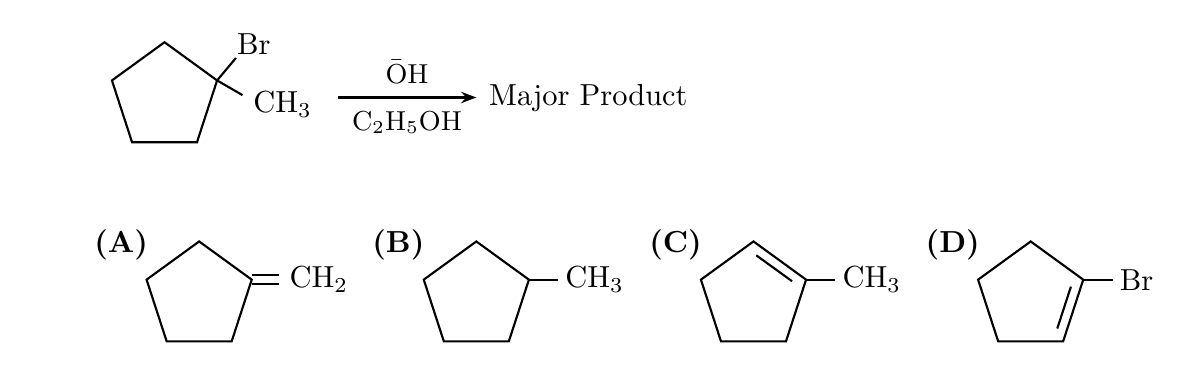
(See figure)
Theory · how these 6 PYQs are the same concept
With a strong small base and heat, E2 removes a β-H anti to the leaving group and forms the more stable alkene: more substituted, or conjugated with a ring or another C=C. Double elimination from dibromides gives conjugated dienes. A β-H made acidic by a neighbouring –I group can steer the product. Trap: missing conjugation with phenyl as the deciding factor.
How NTA asks it
Rotated as the major product of a tertiary cyclic halide, a benzylic case with CH3O⁻, E2 of a bromofluoride, PBr3 then alc. KOH, or a double elimination.
- 2024 (Unique PYQ): Unique PYQ: tertiary cyclic bromide with OH⁻/EtOH gives 1-methylcyclopentene.
- 2021: Same E2; alkene conjugated with the ring wins with CH3O⁻.
- 2020: Same E2; Br leaves and the more acidic H beside F decides the alkene.
- 2019: Same elimination after PBr3; conjugated alkene forms.
- 2019: Same Saytzeff E2 of a tertiary chloride with NaOEt.
- 2019: Same rule twice; excess alc. KOH gives a conjugated diene.
JEE Main 2024 · JEE Main 27 Jan 2024 Shift-I
Stereochemistry: SN2 inversion, SN1 racemisation, untouched stereocentres
SN1/SN2 and Elimination ReactionsAsked 5 times (2020, 2022, 2024, 2026) • Solving this covers 4 similar PYQs
The correct statement regarding nucleophilic substitution reaction in a chiral alkyl halide is ;
Theory · how these 5 PYQs are the same concept
SN2 inverts the configuration at the attacked carbon and is stereospecific. SN1 goes through a planar cation attacked on both faces, so it gives (partial) racemisation and loss of optical activity. If the stereocentre is not the carbon that bears X, its configuration is retained. Trap: assuming SN1 always gives exactly 50:50 or that 'inversion' changes R to S label in every case.
How NTA asks it
Rotated as statement pairs, 'correct statement for a chiral halide', the major product of PhS⁻ in DMF, which compound retains configuration, or optical activity after hydrolysis.
- 2024 (Unique PYQ): Unique PYQ: correct statement on inversion vs racemisation for a chiral alkyl halide.
- 2026: Same idea in statements; tertiary chiral halide hydrolysis racemises; vinyl C–Cl stronger.
- 2024: Same concept as two statements on SN2 stereospecificity and SN1 mixtures.
- 2022: Same SN2 inversion applied to a cyclic secondary iodide with PhS⁻ in DMF.
- 2020: Same idea reversed: stereocentre not at the C–Br carbon, so configuration is retained.
SN1 rate of substituted benzyl halides: ring substituent effect on the cation
Asked 5 times (2019, 2023, 2026) • covers 4 similar PYQs
Unreactive vinyl and aryl C–X: partial double bond, no stable cation
Asked 5 times (2019, 2021, 2024, 2026) • covers 4 similar PYQs
Named preparations: Sandmeyer, Gattermann, Wurtz–Fittig, Fittig, Swarts, Finkelstein
Asked 5 times (2023, 2024, 2025, 2026) • covers 4 similar PYQs
SN1/solvolysis rate from carbocation stability (3°, allylic, benzhydryl, bridgehead)
Asked 5 times (2021, 2023, 2025, 2026) • covers 4 similar PYQs
Predicting products with KCN/AgCN and KNO2/AgNO2 (nitrile vs isocyanide, nitro vs nitrite)
Asked 5 times (2022, 2023, 2024, 2025) • covers 4 similar PYQs
SN2 rate: steric hindrance at the reacting carbon and benzylic/EWG effects
Asked 5 times (2020, 2023, 2024, 2025) • covers 4 similar PYQs
Grignard reagent + water/D2O/alcohol gives R–H or R–D
Asked 5 times (2021, 2022, 2024, 2025) • covers 4 similar PYQs
AgNO3 test: which C–X ionises to precipitate AgX
Asked 5 times (2019, 2020, 2021, 2022, 2023) • covers 4 similar PYQs
Bulky base and Hofmann product vs Saytzeff in elimination
Asked 5 times (2020, 2021, 2022) • covers 4 similar PYQs
Grignard as carbon nucleophile: CO2 to acid, ester to 3° alcohol, then onward
Asked 4 times (2022, 2024, 2025, 2026) • covers 3 similar PYQs
Nucleophilic aromatic substitution activated by ortho/para NO2
Asked 4 times (2021, 2023, 2025) • covers 3 similar PYQs
Carbocation rearrangement in SN1/E1 (hydride and methyl shifts)
Asked 4 times (2019, 2020, 2021) • covers 3 similar PYQs
Classifying halides: vinylic, allylic, benzylic, alkyl by the carbon bearing X
Asked 3 times (2024, 2026) • covers 2 similar PYQs
Counting halogenation/substitution products and their stereoisomers
Asked 3 times (2023, 2024, 2026) • covers 2 similar PYQs
Nucleophilicity order: charge, delocalisation, solvation
Asked 3 times (2019, 2026) • covers 2 similar PYQs
Choosing SN1 vs SN2 from nucleophile strength and solvent polarity
Asked 3 times (2023, 2024, 2025) • covers 2 similar PYQs
Shifting a halogen: dehydrohalogenation then HBr re-addition
Asked 3 times (2019, 2024, 2025) • covers 2 similar PYQs
Ambident nucleophiles: which ion is ambident and why ionic vs covalent salts differ
Asked 3 times (2021, 2024) • covers 2 similar PYQs
Multistep chains through SN2 by CN⁻, NH3 or alkoxide on alkyl halides
Asked 3 times (2024) • covers 2 similar PYQs
Electrophilic substitution of haloarenes: deactivating but ortho/para directing
Asked 3 times (2019, 2023, 2024) • covers 2 similar PYQs
Friedel–Crafts alkylation by halides, including intramolecular ring closure
Asked 3 times (2019, 2020, 2023) • covers 2 similar PYQs
Physical property order of halo compounds: bp, mp, density
Asked 3 times (2021, 2023) • covers 2 similar PYQs
Regiochemistry of HX addition via the more stable carbocation (EWG/aryl effects)
Asked 3 times (2020, 2021, 2022) • covers 2 similar PYQs
SN1 mechanism details: rate law, ion pairs, energy profile
Asked 3 times (2019, 2020) • covers 2 similar PYQs
Selective radical bromination: allylic and tertiary positions
Asked 2 times (2022, 2025) • covers 1 similar PYQ
Neighbouring group participation (phenonium, aziridinium)
Asked 2 times (2024, 2025) • covers 1 similar PYQ
Uses of polyhalogen compounds (CCl4, CH2Cl2, CHI3, freons, DDT)
Asked 2 times (2024) • covers 1 similar PYQ
Side-chain free-radical chlorination of toluenes and onward conversion
Asked 2 times (2022, 2024) • covers 1 similar PYQ
Finkelstein exchange and iodide catalysis
Asked 2 times (2023) • covers 1 similar PYQ
HBr cleavage of epoxides and alkyl aryl ethers
Asked 2 times (2020) • covers 1 similar PYQ
E1 dehydrohalogenation rate order from carbocation stability
Asked 2 times (2020) • covers 1 similar PYQ
Aromatic carbocations (tropylium, cyclopropenium) ionise fastest
Asked 2 times (2019, 2020) • covers 1 similar PYQ
Double dehydrohalogenation to alkyne, then hydration to methyl ketone
Asked in 2026
Structures of named polyhalogen compounds (chloral, gammaxene, chloropicrin, freon)
Asked in 2023
Benzylic nitrile carbanion addition to a ketone
Asked in 2022