General Organic Chemistry
215 PYQs → 54 unique concepts, 161 similar PYQs. The first 3 are free.
JEE Main 2025 · JEE Main 04 Apr 2025 Shift-II
Polyfunctional chains: principal group as suffix, others as prefixes (oxo, formyl)
Nomenclature of Organic CompoundsAsked 9 times (2019, 2020, 2022, 2023, 2024, 2025) • Solving this covers 8 similar PYQs
The IUPAC name of the following compound is -
Theory · how these 9 PYQs are the same concept
When several functional groups are present, the one of highest priority (COOH > ester > CHO > C=O > OH > NH2) becomes the suffix and fixes C-1; the rest become prefixes: =O as oxo, CHO as formyl (or oxo if it ends the chain), OH as hydroxy, NH2 as amino, CN as cyano. The parent chain must contain the principal group and as many multiple bonds as possible. Trap: naming a terminal CHO as formyl when it is part of the main chain, or numbering from the wrong end.
How NTA asks it
Asked as 'IUPAC name of' a keto acid, hydroxy ketone, amino nitrile, nitro oxo enal or en-yn-ol; sometimes as a statement pair comparing a right and a wrong name, or as 'structure of' a named enal.
- 2025 (Unique PYQ): Unique PYQ: name an en-yn-ol chain; OH is the suffix, both multiple bonds kept in the parent.
- 2024: COOH principal with CHO and OH as prefixes (formyl, hydroxy) and a terminal C=C: same method.
- 2024: Statement form: 7-hydroxyheptan-2-one vs 2-oxoheptan-7-ol; ketone outranks alcohol.
- 2024: Amino nitrile: CN is the suffix (butanenitrile) and NH2 a prefix.
- 2024: Reverse form: pick the structure of 4-methylpent-2-enal, CHO fixing C-1.
- 2023: Keto acid: COOH as C-1, ketone named oxo at C-5.
- 2022: Oxo-nitro-enal: CHO is C-1, ketone, nitro and methyl as alphabetical prefixes.
- 2020: Acid with a terminal CHO inside the chain, named 6-oxo, not formyl.
- 2019: Hydroxy acid: COOH as C-1, OH and CH3 as prefixes on a pentanoic acid.
JEE Main 2025 · JEE Main 07 Apr 2025 Shift-I
IUPAC naming of hydrocarbons/haloalkenes: parent chain, lowest locants, alphabetical
Nomenclature of Organic CompoundsAsked 8 times (2019, 2021, 2024, 2025) • Solving this covers 7 similar PYQs
Which of the following is the correct IUPAC name of given organic compound (X) ?
(See figure)
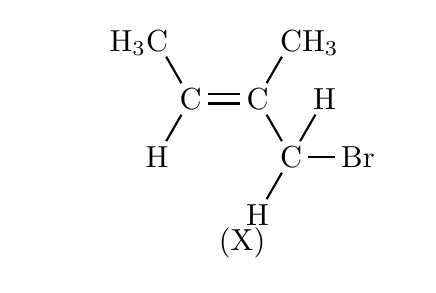
(See figure)
Theory · how these 8 PYQs are the same concept
Pick the longest chain (or ring) that contains the maximum number of multiple bonds, then number it so the multiple bonds get the lowest locants; if ene and yne tie, the double bond gets the lower number. Next apply the lowest-locant-set rule to substituents and cite them alphabetically (ethyl before methyl, multiplying prefixes like di- ignored). Trap: choosing the longest chain that skips the C=C, or citing prefixes in numerical rather than alphabetical order.
How NTA asks it
Given a structure, choose its name; or given the name, pick the structure. Rotated across branched alkanes, gem-dimethyl cycloalkanes, bromoalkenes, en-yne chains with E/Z, and match-the-list of four names.
- 2025 (Unique PYQ): Unique PYQ: name BrCH2-C(CH3)=CH-CH3 (chain must hold the C=C, then lowest locants).
- 2025: Match-the-list form: four alkanes/alkenes paired with their IUPAC names.
- 2024: Same rules on a branched octane: longest chain and lowest locant set for three methyls.
- 2024: Reverse form: draw 2,3-dibromo-1-phenylpentane from its name.
- 2024: Ring version: gem-dimethyl and ethyl on cyclohexane, locant set {1,1,3}, then alphabetical.
- 2021: Hex-2-en-4-yne with Br: tie between ene and yne broken in favour of the double bond, plus E/Z.
- 2019: Hept-6-en-1-yne with a propyl branch: chain chosen to include both multiple bonds.
- 2019: Bromo-methylpentene: same chain-and-locant method on a short haloalkene.
JEE Main 2026 · JEE Main 21 Jan 2026 Shift-II
Types of structural isomers: chain, position, functional, metamers, ring-chain
IsomerismAsked 7 times (2021, 2023, 2024, 2025, 2026) • Solving this covers 6 similar PYQs
Match List-I with List-II.
List-I (Pair of Compounds)
(A) 2-Methylpropene and but-1-ene
(B) Cis-but-2-ene and trans-but-2-ene
(C) 2-Butanol and diethyl ether
(D) But-1-ene and but-2-ene
List-II (Type of Isomers)
(I) Stereoisomers
(II) Position isomers
(III) Chain isomers
(IV) Functional group isomers
Choose the correct answer from the options given below :
Theory · how these 7 PYQs are the same concept
Structural isomers share a molecular formula but differ in connectivity. Chain isomers differ in carbon skeleton, position isomers in the location of a group or multiple bond, functional isomers in the functional group (aldehyde vs ketone, alcohol vs ether, 1 vs 2 degree amine), metamers in the alkyl groups on either side of the same polyvalent group (ethers, ketones, sec-amines). Ring-chain isomers: cycloalkane vs alkene. Trap: two compounds with different formulas are not isomers at all.
How NTA asks it
Mostly match-the-list (pair of compounds vs type of isomerism) or 'identify correct statements'; also 'C3H6O can show' and two-statement forms on ring-chain or amine isomers.
- 2026 (Unique PYQ): Unique PYQ: match four pairs (methylpropene/butene, cis/trans etc.) to isomer types.
- 2026: Statement-set form with propanal/propanone, ethers, butenes and pentanes; same classification.
- 2025: Statements on pentanones, nitrile/isocyanide and alcohols of different formula.
- 2025: Two statements: methylcyclopentane/hex-3-ene (ring-chain) and 1 vs 2 degree amines.
- 2024: Match-the-list again with propanols, ethers, propanone/propanal, pentanes.
- 2023: Match-the-list with amines, hexanones, amide/imidic acid tautomers, nitrophenols.
- 2021: Single formula C3H6O: propanal vs propanone shows functional isomerism.
Aromatic vs antiaromatic cyclic ions: cyclopropenyl, cyclopentadienyl, tropylium
Asked 7 times (2019, 2021, 2022, 2025) • covers 6 similar PYQs
Aromaticity of neutral rings and annulenes: planarity plus 4n+2 pi electrons
Asked 7 times (2021, 2022, 2024) • covers 6 similar PYQs
Identifying chiral centres and optically active compounds among simple molecules
Asked 6 times (2022, 2023, 2024, 2026) • covers 5 similar PYQs
Carbanion stability: s-character, -M/-I groups, aromaticity (basicity is the reverse)
Asked 6 times (2020, 2024, 2026) • covers 5 similar PYQs
Relative stability of resonance structures: octets, charge separation, charge placement
Asked 6 times (2021, 2023, 2024, 2026) • covers 5 similar PYQs
Total stereoisomers = 2^n from chiral centres and stereogenic C=C (fewer with symmetry)
Asked 6 times (2024, 2025) • covers 5 similar PYQs
Carbocation stabilisation by lone-pair donors (+M of OMe, NH2) through conjugation
Asked 6 times (2022, 2023, 2025) • covers 5 similar PYQs
Reading structures: sigma/pi bond counts, carbon degree, hybridisation, bond-line formula
Asked 6 times (2021, 2022, 2024) • covers 5 similar PYQs
Nitrogen basicity: lone pair availability (sp3 > sp2 > delocalised > aromatic sextet)
Asked 6 times (2019, 2020, 2021, 2024) • covers 5 similar PYQs
Acidity of phenols and alcohols: -M/-I raise it, +M/+I lower it, ortho/para vs meta
Asked 6 times (2022, 2023, 2024) • covers 5 similar PYQs
Carboxylic acid strength: -I groups and their distance, +I groups, versus carbonic acid
Asked 6 times (2019, 2021, 2023, 2024) • covers 5 similar PYQs
Condition for geometrical (cis-trans) isomerism: two different groups on each sp2 carbon
Asked 5 times (2020, 2021, 2024, 2025) • covers 4 similar PYQs
Common (trivial) names and their IUPAC equivalents
Asked 5 times (2021, 2022, 2024) • covers 4 similar PYQs
Enol content raised by conjugation, chelating H-bond and aromaticity
Asked 5 times (2019, 2021, 2022, 2023, 2024) • covers 4 similar PYQs
Resonance (mesomeric) effect basics: conjugation needed, +R/-R groups, hybrid is real
Asked 5 times (2021, 2023, 2024) • covers 4 similar PYQs
Active methylene acidity: carbanion delocalised over C=O, CN or phenyl groups
Asked 5 times (2019, 2020, 2023, 2024) • covers 4 similar PYQs
Counting stereocentres in natural products and drugs
Asked 5 times (2020, 2023) • covers 4 similar PYQs
Conformations of n-butane: anti < gauche < partly eclipsed < fully eclipsed energy
Asked 4 times (2021, 2022, 2023, 2026) • covers 3 similar PYQs
Chirality from subtle differences: D vs H, E vs Z groups, newly formed centres, meso
Asked 4 times (2022, 2023, 2026) • covers 3 similar PYQs
Bond length and dipole moment changed by resonance (partial double-bond character)
Asked 4 times (2020, 2025) • covers 3 similar PYQs
Naming substituted benzenes: benzoic acid/benzaldehyde parents and lowest locant set
Asked 4 times (2019, 2020, 2024, 2025) • covers 3 similar PYQs
Counting substitution/addition products, including stereoisomers
Asked 4 times (2020, 2022, 2023, 2025) • covers 3 similar PYQs
Carbocation stability order: aromatic, resonance, hyperconjugation, then 3 > 2 > 1 > vinyl
Asked 4 times (2021, 2024, 2025) • covers 3 similar PYQs
Nucleophiles and electrophiles: identifying them and ranking nucleophilicity
Asked 4 times (2022, 2023, 2025) • covers 3 similar PYQs
Stability order: aromatic > non-aromatic > antiaromatic; resonance energy of benzene
Asked 4 times (2022, 2023, 2024, 2025) • covers 3 similar PYQs
Conformations of ethane-type molecules: torsional strain, staggered vs eclipsed
Asked 4 times (2019, 2021, 2024) • covers 3 similar PYQs
Counting hyperconjugative structures: number of alpha C-H bonds next to the cation centre
Asked 3 times (2023, 2024, 2026) • covers 2 similar PYQs
Electromeric effect (+E/-E) and comparing it with inductive and other effects
Asked 3 times (2024, 2026) • covers 2 similar PYQs
Nature of hyperconjugation: permanent sigma-p overlap; more alkyl groups, more stability
Asked 3 times (2021, 2025, 2026) • covers 2 similar PYQs
Properties of cis and trans isomers: dipole moment, boiling and melting point
Asked 3 times (2024, 2025) • covers 2 similar PYQs
Counting structural isomers of a molecular formula
Asked 3 times (2021, 2024, 2025) • covers 2 similar PYQs
Reactive intermediates: carbocation, radical, nucleophile, electrophile by structure
Asked 3 times (2024, 2025) • covers 2 similar PYQs
Substituent effects on a benzene ring: activation, directing, diazonium salt stability
Asked 3 times (2022, 2023, 2025) • covers 2 similar PYQs
Functional groups, homologous series and IUPAC priority order of groups
Asked 3 times (2022, 2024) • covers 2 similar PYQs
Bond fission and free radicals: homolysis vs heterolysis, radical generation steps
Asked 3 times (2022, 2024) • covers 2 similar PYQs
Carbocation stability consequences: AgNO3 ionisation, hydride affinity, rate
Asked 3 times (2021, 2023) • covers 2 similar PYQs
Aromaticity through charge-separated forms: tropolone, squarate, protonated cyclopropenone
Asked 3 times (2020, 2023) • covers 2 similar PYQs
Ranking labelled protons of different types: COOH > phenol > activated C-H > alkyne C-H
Asked 3 times (2020, 2022, 2023) • covers 2 similar PYQs
Ring carrying the principal group: that ring carbon is C-1 (cycloalkenol, ring COOH)
Asked 2 times (2020, 2024) • covers 1 similar PYQ
Classifying organic compounds: alicyclic, heterocyclic, aromatic, spiro and bicyclic
Asked 2 times (2022, 2024) • covers 1 similar PYQ
Spotting metamers: same functional group, different alkyl groups on each side
Asked 2 times (2021, 2024) • covers 1 similar PYQ
C-H acidity from hybridisation: sp > sp2 > sp3
Asked 2 times (2019, 2024) • covers 1 similar PYQ
Stereoisomers of disubstituted cycloalkanes: cis/trans plus meso
Asked 2 times (2021, 2022) • covers 1 similar PYQ
Acidity of C-H or N-H when removal creates an aromatic anion
Asked 2 times (2019, 2021) • covers 1 similar PYQ
Amidines and guanidines: strong bases via resonance-stabilised conjugate acid
Asked 2 times (2020) • covers 1 similar PYQ
Basicity of substituted anilines: para donors raise it, withdrawing groups lower it (pKb)
Asked 2 times (2019, 2020) • covers 1 similar PYQ
Naming esters: alkyl group first, then the acid part as alkanoate
Asked in 2026
Free radical stability: resonance (propargylic, allylic) > 3 > 2 > 1 > vinyl/alkynyl
Asked in 2025
Conjugate base strength: the weaker the acid, the stronger its conjugate base
Asked in 2024
Optical purity (ee) = observed rotation / rotation of pure enantiomer x 100
Asked in 2022
Racemic vs non-racemic products: planar intermediate attacked from both faces
Asked in 2020